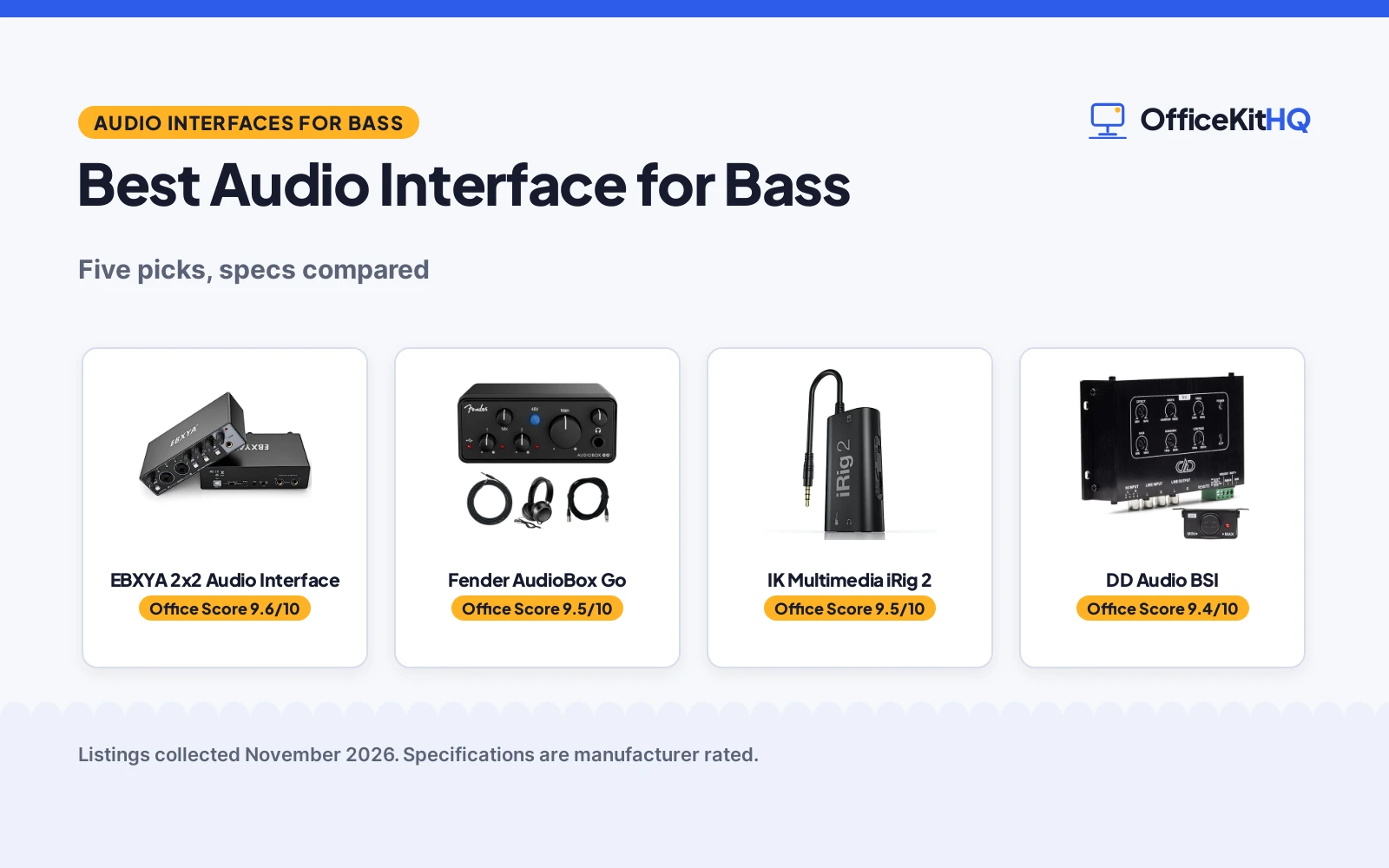
A bass track starts with a clean signal, and the best audio interface for bass is the interface that keeps that signal clean from the instrument to the computer. We compared interfaces by inputs, preamp gain, resolution, phantom power and warranty, using only what each maker publishes, to find which fits a bass guitar, a subwoofer stage and a phone setup.
OfficeKitHQ earns a commission when you buy through links on this page, at no extra cost to you. As an Amazon Associate I earn from qualifying purchases. Affiliate disclosure.
Quick picks
 Best Overall EBXYA 2×2 Audio Interface: 24-bit/192kHz, 2 combo inputs, 60 dB gain, 48V phantom, 2-year warranty Check price on Amazon
 Best Bundle Fender AudioBox Go: 24-bit/96 kHz, XMAX-L preamp, 50 dB gain, headphones and cables included Check price on Amazon
 Best Bass Shaping DD Audio BSI: Parametric bass processing, 24 dB/octave subsonic and low-pass filters Check price on Amazon
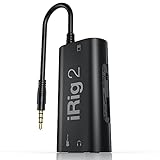 For iPhone and iPad IK Multimedia iRig 2: Portable guitar interface with Amp Out for iPhone and iPad Check price on Amazon
 For Phone Recording JOYO MOMIX CAB: Guitar interface for phone with direct monitoring and USB-C Check price on Amazon
Our desk picks
| # | Product | Office Score | Buy |
|---|---|---|---|
| 1 | EBXYA 2x2 Audio Interface | 9.6/10 | Buy on Amazon |
| 2 | Fender AudioBox Go | 9.5/10 | Buy on Amazon |
| 3 | IK Multimedia iRig 2 | 9.5/10 | Buy on Amazon |
| 4 | DD Audio BSI | 9.4/10 | Buy on Amazon |
| 5 | JOYO MOMIX CAB | 9.4/10 | Buy on Amazon |

EBXYA 2x2 Audio Interface
A 2-in, 2-out USB interface recording at 24-bit/192kHz with 2 XLR/Line combo inputs, 60 dB of input gain, a HI-Z switch and 48V phantom power.
Pros
- 24-bit/192kHz recording, the highest resolution stated here
- 2 XLR/Line combo inputs with 60 dB of input gain
- HI-Z switch for high-impedance instruments
- 48V phantom power and 2 balanced TRS outputs
Cons
- 2 inputs only, so larger sessions need a bigger interface
- Ships as the interface alone, without the headphones and cables the Fender bundle includes
- Phantom power and HI-Z add settings to manage before recording
- One headphone output, so two listeners cannot monitor separately
Detailed Review
The EBXYA 2x2 records at 24-bit/192kHz through 2 XLR/Line combo inputs, with a preamp that provides a maximum of 60 dB of input gain and a HI-Z switch for high-impedance instruments. It supplies 48V phantom power for condenser microphones, and it has 2 balanced TRS main outputs plus a stereo headphone output with independent level control. The maker lists plug-and-play use with Mac, PC and mobile devices, and a 2-year warranty.
Who it's for: anyone recording bass guitar and vocals together who wants the highest stated resolution here. Who should skip it: anyone who needs more than 2 inputs or a bundle with headphones and cables.
Its Office Score of 9.6/10 comes from performance 32/35, build 21/25, value 21/25, safety 0/10 and warranty 3/5: 77 of 100 points, placed on our 9.2 to 9.8 scale.
Key Specifications
| Resolution | 24-bit/192kHz |
|---|---|
| Inputs | 2 XLR/Line combo |
| Preamp gain | 60 dB max |
| Phantom power | 48V |
These specs mirror the retailer listing as of 20 November 2026; performance figures are stated by the brand.
Safety and Warranty
What this listing states. No volume limit or safety listing is stated, so safety scores zero. 2-year warranty. It does not say everything a buyer needs, such as who pays return shipping, so warranty scores 3 of 5. See How We Pick.
Protect your hearing. Keep volume moderate during long calls, take breaks, and treat noise cancelling and battery figures as the maker's claims.
This is general buying information, not professional advice. Follow each product manual and local rules, and see our Safety Disclaimer.

Fender AudioBox Go
A USB-C bus-powered bundle with an XMAX-L mic preamp, 48V phantom power, 24-bit/96 kHz recording and zero-latency monitoring, plus headphones and cables.
Pros
- XMAX-L mic preamp with up to 50 dB of gain
- Records mic and instrument at the same time
- Headphones, XLR cable and instrument cable included
- USB-C bus-powered with zero-latency monitoring
Cons
- No warranty term is stated
- 24-bit/96 kHz is lower resolution than the EBXYA at 24-bit/192kHz
- Only 1 mic preamp, so two mics cannot be recorded together
- 2 inputs only, so larger sessions need a bigger interface
Detailed Review
The Fender AudioBox Go records mic and instrument at the same time through one XMAX-L mic/line combo input and one dedicated TS instrument input. The XMAX-L preamp offers up to 50 dB of gain with 48V phantom power, and the unit records at up to 24-bit/96 kHz over USB-C with zero-latency monitoring through the Mix control. The bundle adds headphones for monitoring and XLR and instrument cables, and the unit weighs 0.85 lb.
Who it's for: anyone who wants a pocket-size bundle for songwriting and demos with headphones and cables in the box. Who should skip it: anyone who needs more than 2 inputs or a stated warranty term.
Its Office Score of 9.5/10 comes from performance 30/35, build 21/25, value 22/25, safety 0/10 and warranty 0/5: 73 of 100 points, placed on our 9.2 to 9.8 scale.
Key Specifications
| Resolution | 24-bit/96 kHz |
|---|---|
| Inputs | 1 XMAX-L combo, 1 TS |
| Preamp gain | 50 dB max |
| Weight | 0.85 lb |
These specs mirror the retailer listing as of 20 November 2026; performance figures are stated by the brand.
Safety and Warranty
What this listing states. No volume limit or safety listing is stated, so safety scores zero. No warranty term, so warranty scores zero. See How We Pick.
Protect your hearing. Keep volume moderate during long calls, take breaks, and treat noise cancelling and battery figures as the maker's claims.
This is general buying information, not professional advice. Follow each product manual and local rules, and see our Safety Disclaimer.
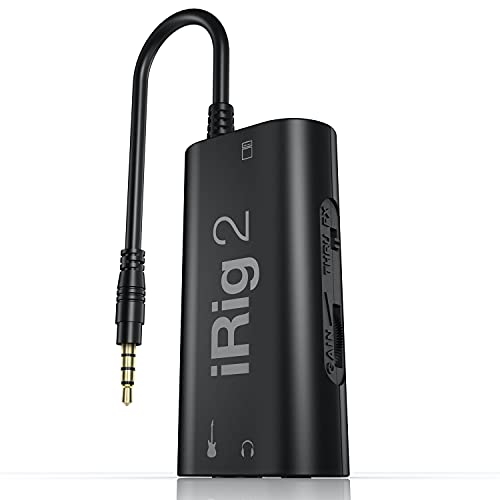
IK Multimedia iRig 2
A portable guitar interface for iPhone and iPad with an adjustable gain dial, a headphone out, a 1/4 in amp out and a switch for processed or clean signal.
Pros
- 1/4 in amp output connects to an amplifier without an adapter
- FX/THRU switch selects a processed signal or a clean thru signal
- Adjustable gain dial works with the built-in 1/8 in TRRS output
- AmpliTube CS for iOS is paired with the interface
Cons
- Newer iOS devices need an Apple-brand USB-C to 3.5mm adapter
- Warranty splits into 1 year for parts and 90 days for labor
- No USB-C or Lightning connection is stated; it uses a 1/8 in TRRS output
- No sample rate is stated in the listing
Detailed Review
IK Multimedia lists the iRig 2 as a portable guitar interface for iPhone and iPad with an instrument input, a headphone out and a 1/4 in amplifier out. The listing states an adjustable gain dial, a 1/8 in TRRS output connector, a switch for a processed signal or a clean thru signal, and AmpliTube CS for iOS. The spec table gives dimensions of 6.25 in by 5.5 in by 1.75 in and an item weight of 0.22 lb, and the listing states a 1-year parts warranty with a 90-day labor warranty.
Who it's for: someone who plays guitar into an iPhone or iPad and wants an amp out with a processed or clean signal switch. Who should skip it: anyone who needs a USB-C connection, a mic input, or a stated sample rate.
Its Office Score of 9.5/10 comes from performance 28/35, build 20/25, value 20/25, safety 0/10 and warranty 2/5: 70 of 100 points, placed on our 9.2 to 9.8 scale.
Key Specifications
| Input | Instrument |
|---|---|
| Outputs | 1/8 in headphone, 1/4 in amp |
| Gain | Adjustable dial |
| Item weight | 0.22 lb |
Figures as published on the retailer listing, collected 10 November 2026. Performance figures are manufacturer rated.
Safety and Warranty
What this listing states. This product does not plug in or run on a battery, so safety is not part of its score. One year parts warranty, 90 days labor warranty. It does not say everything a buyer needs, such as who pays return shipping, so warranty scores 2 of 5. See How We Pick.
Protect your hearing. Keep volume moderate during long calls, take breaks, and treat noise cancelling and battery figures as the maker's claims.
This is general buying information, not professional advice. Follow each product manual and local rules, and see our Safety Disclaimer.

DD Audio BSI
A bass signal interface that restores, enhances and controls low-frequency content in a subwoofer stage, with parametric bass processing and 24 dB/octave subsonic and low-pass filters.
Pros
- Parametric bass processing with 24 dB/octave filters
- Differential-balanced RCA and high-level inputs
- Selectable input-voltage range and automatic turn-on
- 1 Year Warranty stated
Cons
- Built for a subwoofer stage, not for recording bass to a computer
- RCA and high-level inputs only, with no mic input
- 2.0 lb, the heaviest unit here
- Made for OEM and aftermarket integration, not a home desk setup
Detailed Review
The DD Audio BSI is a bass signal interface for restoring, enhancing and controlling low-frequency content in a subwoofer stage. Its processing includes variable parametric bass processing plus 24 dB/octave subsonic and low-pass filters, with differential-balanced RCA inputs, high-level inputs, a selectable input-voltage range and automatic turn-on options. The maker lists a 1 Year Warranty, and the unit weighs 2.0 lb.
Who it's for: anyone shaping bass in a subwoofer stage who needs parametric control and steep filters. Who should skip it: anyone who wants to record bass guitar to a computer, since this unit has no USB recording connection.
Its Office Score of 9.4/10 comes from performance 28/35, build 20/25, value 19/25, safety 0/10 and warranty 2/5: 69 of 100 points, placed on our 9.2 to 9.8 scale.
Key Specifications
| Filters | 24 dB/octave subsonic, low-pass |
|---|---|
| Inputs | RCA, high-level |
| Weight | 2.0 lb |
| Warranty | 1 Year |
These specs mirror the retailer listing as of 20 November 2026; performance figures are stated by the brand.
Safety and Warranty
What this listing states. This product does not plug in or run on a battery, so safety is not part of its score. 1 Year Warranty. It does not say everything a buyer needs, such as who pays return shipping, so warranty scores 2 of 5. See How We Pick.
Protect your hearing. Keep volume moderate during long calls, take breaks, and treat noise cancelling and battery figures as the maker's claims.
This is general buying information, not professional advice. Follow each product manual and local rules, and see our Safety Disclaimer.

JOYO MOMIX CAB
A pocket guitar interface for phone with direct monitoring, a 6.35mm input, a 3.5mm headphone out and USB-C and Lightning connections.
Pros
- Direct monitoring passes the clean signal to headphones with zero latency
- USB-C cable and Lightning adapter are included for wide device compatibility
- Pocket size with a back clip for a pocket, belt or guitar strap
- Signal light glows green for a clean signal and red when the input is too hot
Cons
- Dry signal cannot be muted, and the interface is not designed for real-time amp sims
- Use only the included USB-C cable; third-party cables may not work
- Android use needs OTG enabled in the phone settings
- The listing states compatibility varies by Android model
Detailed Review
JOYO lists the MOMIX CAB as a direct monitoring guitar interface for phone, with a 6.35mm input, a 3.5mm headphone out, USB-C and Lightning plug and play, and a pocket size with a back clip. The listing states the clean signal passes straight to the headphone output with zero latency while sending to the phone for recording, and the signal light glows green for a clean signal and red when the input is too hot. The spec table gives dimensions of 1.14 in by 2.52 in by 0.79 in, and the listing states a one year after-sale service.
Who it's for: someone who records dry guitar tracks to a phone and wants direct monitoring with zero latency. Who should skip it: anyone who needs real-time amp sims, a muted dry signal, or a mic input.
Its Office Score of 9.4/10 comes from performance 29/35, build 21/25, value 21/25, safety 0/10 and warranty 0/5: 71 of 100 points, placed on our 9.2 to 9.8 scale.
Key Specifications
| Size | 1.14 x 2.52 x 0.79 in |
|---|---|
| Input | 6.35mm guitar |
| Headphone | 3.5mm out |
| Item weight | 0.04 lb |
Figures as published on the retailer listing, collected 10 November 2026. Performance figures are manufacturer rated.
Safety and Warranty
What this listing states. This product does not plug in or run on a battery, so safety is not part of its score. No warranty term, so warranty scores zero. See How We Pick.
Protect your hearing. Keep volume moderate during long calls, take breaks, and treat noise cancelling and battery figures as the maker's claims.
This is general buying information, not professional advice. Follow each product manual and local rules, and see our Safety Disclaimer.
As an Amazon Associate I earn from qualifying purchases.
Specs compared
| Interface | Office Score | Resolution | Inputs | Preamp gain | Phantom power | Warranty | Amazon |
|---|---|---|---|---|---|---|---|
| EBXYA 2×2 Audio Interface | 9.6/10 | 24-bit/192kHz | 2 XLR/Line combo | 60 dB max | 48V | 2-year | |
| Fender AudioBox Go | 9.5/10 | 24-bit/96 kHz | 1 XMAX-L combo, 1 TS | 50 dB max | 48V | Not stated | View on Amazon |
| DD Audio BSI | 9.4/10 | Not stated | RCA, high-level | Not stated | Not stated | 1 Year | View on Amazon |
| IK Multimedia iRig 2 | 9.5/10 | Not stated | Not stated | Not stated | Not stated | Not stated | View on Amazon |
| JOYO MOMIX CAB | 9.4/10 | Not stated | Not stated | Not stated | Not stated | Not stated | View on Amazon |
Dimensions, weight limits and ranges are the maker’s ratings as each listing gives them, collected 20 November 2026.
How to choose the best audio interface for bass
Match the input to your bass
A bass guitar plugs into an instrument input, and the right input keeps the signal strong. The EBXYA has a HI-Z switch for high-impedance instruments, and the Fender has a dedicated TS instrument input beside its XMAX-L combo input. The iRig 2 and the JOYO are guitar interfaces for a phone, so they suit mobile recording rather than a studio desk. The DD Audio BSI has RCA and high-level inputs for a subwoofer stage, not an instrument input, so it does not record a bass guitar.
Check the resolution and the gain
Resolution sets how much detail the recording keeps, and gain sets how loud the input can go before the preamp runs out. The EBXYA records at 24-bit/192kHz with up to 60 dB of gain, while the Fender records at 24-bit/96 kHz with up to 50 dB of gain. Higher gain suits a quiet bass, and higher resolution suits a detailed mix, so match both figures to the recording you plan in your DAW.
| Interface | Resolution | Preamp gain |
|---|---|---|
| EBXYA 2×2 Audio Interface | 24-bit/192kHz | 60 dB max |
| Fender AudioBox Go | 24-bit/96 kHz | 50 dB max |
| DD Audio BSI | Not stated | Not stated |
Count the inputs and the outputs
Two inputs let you record bass and vocals together, while one input means one source at a time. The EBXYA has 2 XLR/Line combo inputs, 2 balanced TRS main outputs and a stereo headphone output, so it covers a mic, an instrument and speakers in one unit. The Fender has one XMAX-L combo input and one TS instrument input, so it records a mic and an instrument together, and its bundle adds headphones and cables. Check the headphone output too: the EBXYA gives it independent level control, which helps when you monitor while recording.
Phantom power, bundles and phone recording
Phantom power matters only if you record with a condenser microphone: the EBXYA and the Fender both supply 48V, while the DD Audio BSI needs none, since it processes a subwoofer stage rather than a microphone. A bundle saves a separate purchase: the Fender bundle includes headphones and XLR and instrument cables. For phone recording, the iRig 2 suits iPhone and iPad and the JOYO suits a phone over USB-C, so match the interface to the device you record on. Our guide to the best audio interface for iOS covers phone recording in more depth.
FAQ
Do I need a special interface to record a bass guitar?
No special interface is needed: any interface with an instrument input records a bass guitar. The EBXYA suits a bass best here, with a HI-Z switch for high-impedance instruments and up to 60 dB of gain, while the Fender gives the bass its own TS instrument input.
What does 48V phantom power do on an audio interface?
Phantom power runs condenser microphones, which need power to work. The EBXYA and the Fender both supply 48V, while dynamic microphones and instruments do not need it.
Can I record bass and vocals at the same time?
Yes, with an interface that has two inputs. The EBXYA has 2 XLR/Line combo inputs, and the Fender records a mic and an instrument at the same time through its XMAX-L combo input and TS instrument input.
What is the DD Audio BSI for?
The BSI is a bass signal interface for a subwoofer stage, not a USB recording interface. It restores, enhances and controls low-frequency content with parametric bass processing and 24 dB/octave subsonic and low-pass filters.
Do I need headphones with an audio interface?
Headphones let you monitor while recording, and the Fender bundle includes headphones with XLR and instrument cables. The EBXYA has a stereo headphone output with independent level control, so you can set the monitor level apart from the main outputs.
Score breakdown
The Office Score weighs performance (inputs, preamp gain, resolution and phantom power for recording), build (construction and weight), value for the stated specs, safety and warranty. For an audio interface, safety means a stated electrical safety feature or certification, and none of the five listings states one, so every safety score is zero. Two listings state a warranty term: the EBXYA at 2 years and the DD Audio BSI at 1 Year. How we pick explains the weights.
| Product | Office Score | Perf. /35 | Build /25 | Value /25 | Safety /10 | Warranty /5 |
|---|---|---|---|---|---|---|
| EBXYA 2×2 Audio Interface | 9.6 | 32 | 21 | 21 | 0 | 3 |
| Fender AudioBox Go | 9.5 | 30 | 21 | 22 | 0 | 0 |
| DD Audio BSI | 9.4 | 28 | 20 | 19 | 0 | 2 |
Office Scores run on a short 9.2 to 9.8 scale. We place each item’s weighted point total on it in proportion, so a larger total is always shown as a larger score.
More for your workspace
See every Audio, Power and Connectivity guide and all Home Studio guides. Also see our best audio interface for guitar recording. Also see our best audio interface for live.
More picks: best audio interface for DAW, best audio interface for iOS, best audio interface with DSP.