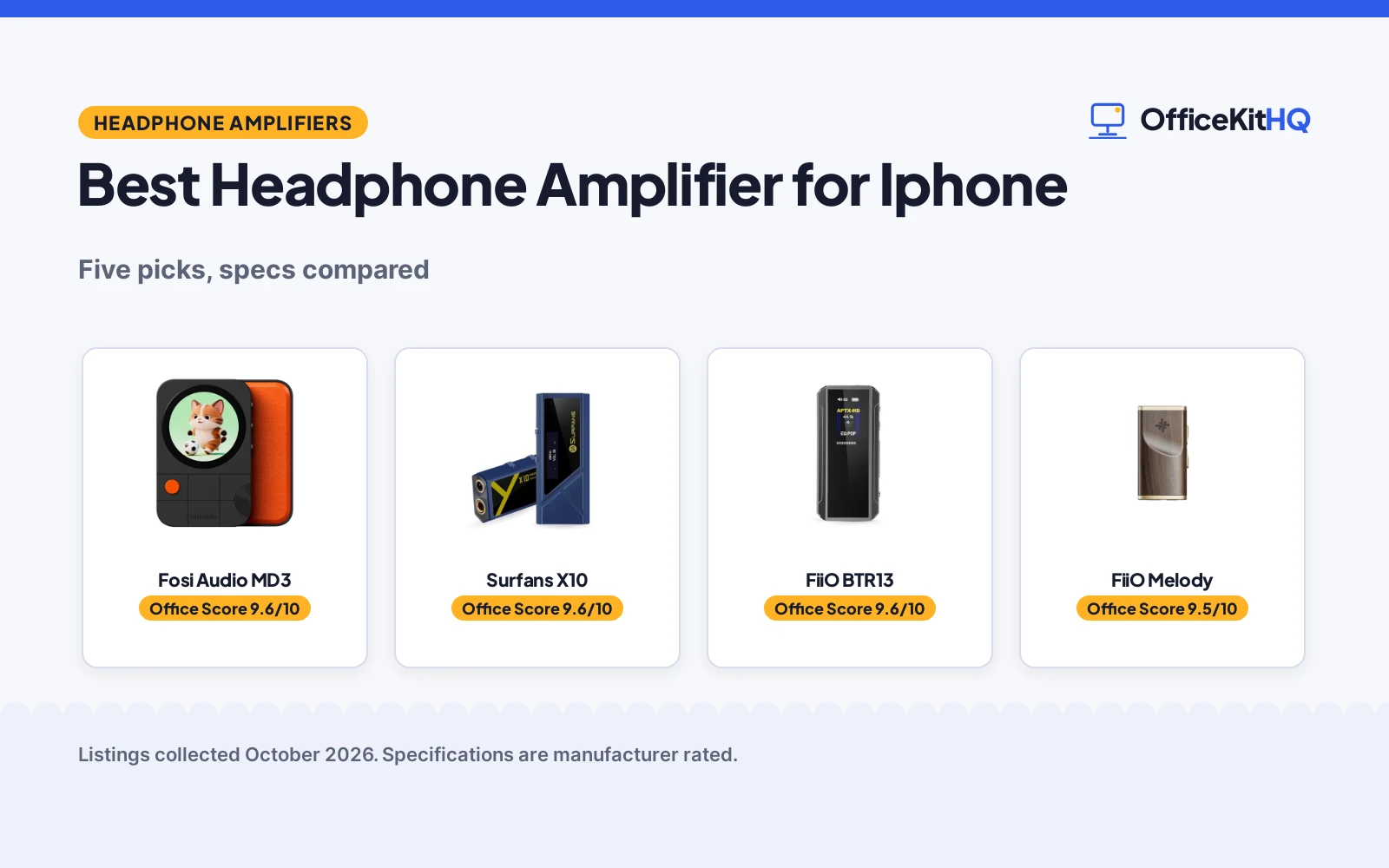
The best headphone amplifier for iphone at a home desk is the small adapter that lets wired headphones stay plugged in between calls and music without swapping cables at the edge of the desk. A phone propped beside a keyboard, a headset cable across a notebook and a call that runs into focused work are the usual setup here. We compared portable DAC headphone amplifiers by connector, stated output power, outputs, sample rate figures, controls, stated weight and warranty term, using only what each maker publishes.
OfficeKitHQ earns a commission when you buy through links on this page, at no extra cost to you. As an Amazon Associate I earn from qualifying purchases. Affiliate disclosure.
Quick picks
 Best Overall Fosi Audio MD3: Dual USB-C ports, screen volume control, 180mW at 32Ω stated Check price on Amazon
 Best Balanced Power Surfans X10: Up to 522mW balanced, OLED screen, adjustable gain stated Check price on Amazon
 Best Bluetooth Option FiiO BTR13: Bluetooth and USB modes, 220mW+220mW balanced stated Check price on Amazon
 Best Wood Housing FiiO Melody: Walnut housing, 10-Band PEQ, 384kHz/32-bit stated Check price on Amazon
 Best Simple Dongle JCALLY JM7 MAX: USB-C to 3.5mm, 32-bit/384kHz and DSD256 stated Check price on Amazon
Our desk picks
| # | Product | Office Score | Buy |
|---|---|---|---|
| 1 | Fosi Audio MD3 | 9.6/10 | Buy on Amazon |
| 2 | Surfans X10 | 9.6/10 | Buy on Amazon |
| 3 | FiiO BTR13 | 9.6/10 | Buy on Amazon |
| 4 | FiiO Melody | 9.5/10 | Buy on Amazon |
| 5 | JCALLY JM7 MAX | 9.4/10 | Buy on Amazon |

Fosi Audio MD3
A portable USB-C DAC amplifier with dual outputs, a circular screen and magnetic back panel for phone use.
Pros
- Dual USB-C ports support charging and playback at the same time
- 3.5mm and 4.4mm outputs state 80mW and 180mW at 32Ω
- 100-level volume control with volume memory and a 1.28-inch screen
- 24 Months Manufacturer warranty term is stated
Cons
- 50g stated weight is higher than the 28.6g FiiO BTR13
- Balanced output at 180mW is lower than the 522mW Surfans figure
- USB-C connection suits USB-C phones, with iPhone 15 listed
- Screen games and custom images add controls beyond plain playback
Detailed Review
Fosi Audio lists the MD3 with an ESS ES9039Q2M DAC chip and four ES9603Q amplifier chips, with THD+N as low as 0.00075% and frequency response from 20 Hz to 48 kHz. Compatibility is stated for 16 to 300 Ω headphones, studio monitors and IEMs. The maker states 50g weight, 12mm thickness, dual USB-C ports, 3.5mm single-end and 4.4mm balanced outputs at 80mW and 180mW at 32Ω, an aluminum unibody with magnetic leather back panel, and a 1.28-inch circular screen. Support covers UAC 2.0 and UAC 1.0, with iPhone 15, Android, iPad, Mac and Windows PCs listed.
Who it's for: a USB-C iPhone owner who wants screen volume control, charging during playback and both output sockets in one small unit. Who should skip it: a buyer who needs Bluetooth, or who wants the higher stated balanced power of the Surfans X10.
Its Office Score of 9.6/10 comes from performance 30/35, build 22/25, value 21/25, safety 0/10 and warranty 4/5: 77 of 100 points, placed on our 9.2 to 9.8 scale.
Key Specifications
| DAC chip | ESS ES9039Q2M |
|---|---|
| Outputs | 3.5mm and 4.4mm |
| Output power | 80mW and 180mW at 32Ω |
| Weight | 50g |
These specs mirror the retailer listing as of 19 November 2026; performance figures are stated by the brand.
Safety and Warranty
What this listing states. No volume limit or safety listing is stated, so safety scores zero. 24 Months Manufacturer. It does not say everything a buyer needs, such as who pays return shipping, so warranty scores 4 of 5. See How We Pick.
Protect your hearing. Keep volume moderate during long calls, take breaks, and treat noise cancelling and battery figures as the maker's claims.
This is general buying information, not professional advice. Follow each product manual and local rules, and see our Safety Disclaimer.
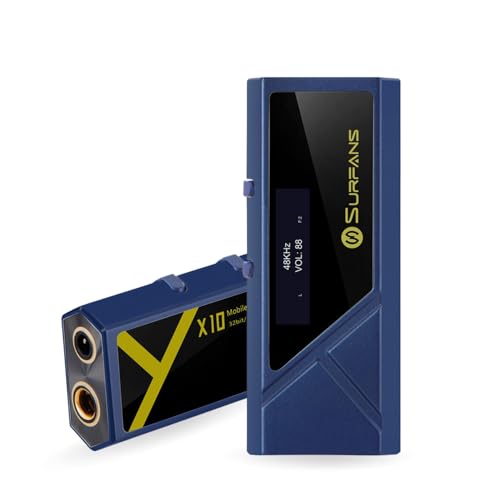
Surfans X10
A USB-C dongle DAC amplifier with balanced output, OLED screen and adjustable gain for wired headphones.
Pros
- Balanced output states up to 522mW from the 4.4mm socket
- THD+N is stated below 0.0006% with ES9028Q2M and ES9603Q chips
- 0.87 inch OLED screen with physical buttons and adjustable gain
- No driver or battery is required for USB-C phone use
Cons
- No sample rate figure in kHz is stated for comparison
- No item weight is stated for carry comparison
- Wired USB-C use only, with no Bluetooth stated
- Balanced power figure gives no impedance load for the 522mW value
Detailed Review
Surfans lists the X10 with an ES9028Q2M DAC and ES9603Q amplifier, with THD+N below 0.0006%. Balanced output is stated at up to 522mW from the 4.4mm socket, alongside a 3.5mm single-ended output. The maker states USB-C use with iPhone, Android phones, tablets, Windows PCs, Mac and compatible music players, with no driver or battery required. Controls include a 0.87 inch OLED screen, physical buttons, adjustable gain modes and digital filter options in an aluminum body. No sample rate figure and no item weight are stated.
Who it's for: a wired headphone owner who wants the highest stated balanced power figure here and screen controls without a battery to charge. Who should skip it: a buyer who needs Bluetooth, or who wants a stated sample rate figure in kHz before choosing.
Its Office Score of 9.6/10 comes from performance 32/35, build 21/25, value 22/25, safety 0/10 and warranty 3/5: 78 of 100 points, placed on our 9.2 to 9.8 scale.
Key Specifications
| DAC chip | ES9028Q2M |
|---|---|
| Outputs | 3.5mm and 4.4mm |
| Output power | Up to 522mW balanced |
| Weight | Not stated |
These specs mirror the retailer listing as of 19 November 2026; performance figures are stated by the brand.
Safety and Warranty
What this listing states. No volume limit or safety listing is stated, so safety scores zero. 1year. It does not say everything a buyer needs, such as who pays return shipping, so warranty scores 3 of 5. See How We Pick.
Protect your hearing. Keep volume moderate during long calls, take breaks, and treat noise cancelling and battery figures as the maker's claims.
This is general buying information, not professional advice. Follow each product manual and local rules, and see our Safety Disclaimer.

FiiO BTR13
A Bluetooth and USB headphone amplifier with dual DAC chips, PEQ controls and balanced output.
Pros
- Bluetooth formats include LDAC, aptX Adaptive and aptX HD
- Balanced output states 220mW+220mW with dual CS43131 chips
- PC, BT and PHONE switch covers computer, Bluetooth and phone modes
- 28.6g stated weight is lower than the 50g Fosi Audio MD3
Cons
- Sampling rate states up to 96kHz, below the 384kHz figures elsewhere
- No housing material is stated for build comparison
- Bluetooth use adds pairing steps beside plain USB-C dongles
- PEQ sharing and app tuning add setup beyond plug and play use
Detailed Review
FiiO lists the BTR13 with a Qualcomm QCC5125 Bluetooth chip and dual Cirrus Logic CS43131 DAC chips, one for each stereo channel. Bluetooth formats stated are LDAC, aptX, aptX LL, aptX Adaptive, aptX HD, AAC and SBC, with up to 96kHz sampling rate by Bluetooth or USB. A PC, BT and PHONE three-position switch moves between computer sound card, Bluetooth decoding and mobile phone modes. Preset effects and app or web adjustment cover EQ frequencies, gain and bandwidth. Weight is stated at 28.6g, with balanced output at 220mW+220mW and 3.5mm and 4.4mm outputs.
Who it's for: a desk user who moves between phone, computer and Bluetooth sources and wants PEQ adjustment in one light unit. Who should skip it: a buyer who wants the 384kHz sample rate figures stated for the Melody or JM7 MAX.
Its Office Score of 9.6/10 comes from performance 30/35, build 20/25, value 22/25, safety 0/10 and warranty 3/5: 75 of 100 points, placed on our 9.2 to 9.8 scale.
Key Specifications
| DAC chip | Dual CS43131 |
|---|---|
| Outputs | 3.5mm and 4.4mm |
| Output power | 220mW+220mW balanced |
| Weight | 28.6g |
These specs mirror the retailer listing as of 19 November 2026; performance figures are stated by the brand.
Safety and Warranty
What this listing states. No volume limit or safety listing is stated, so safety scores zero. 1 year. It does not say everything a buyer needs, such as who pays return shipping, so warranty scores 3 of 5. See How We Pick.
Protect your hearing. Keep volume moderate during long calls, take breaks, and treat noise cancelling and battery figures as the maker's claims.
This is general buying information, not professional advice. Follow each product manual and local rules, and see our Safety Disclaimer.

FiiO Melody
A portable DAC amplifier in walnut and maple wood with 10-Band PEQ and dual outputs.
Pros
- PCM 384kHz/32-bit and DSD256 decoding are stated
- 10-Band PEQ states 3 saved custom presets via app or web
- 3.5mm output doubles as SPDIF coaxial alongside 4.4mm balanced
- Walnut and maple wood housing with tactile buttons is stated
Cons
- No output power figure is stated for headphone matching
- No item weight is stated for carry comparison
- Headset controls may be restricted on iOS and some Android devices
- Wood housing and PEQ setup suit desk use more than pocket use
Detailed Review
FiiO lists the Melody in walnut and maple wood housing with CNC carving, polishing and oil finishing, plus tactile buttons. Dual CS43131 DACs support PCM 384kHz/32-bit and DSD256 decoding. Custom 10-Band PEQ runs through the Fiio Control App or web interface, with 3 custom presets to save and share. Outputs cover 3.5mm single-ended and 4.4mm balanced, with the 3.5mm socket doubling as SPDIF coaxial, detachable cables for Android, iOS, PC and Mac, and a UAC 1.0 and 2.0 toggle. No output power figure and no item weight are stated.
Who it's for: a listener who wants PEQ presets, high stated sample rate figures and a wood housing for desk and phone use. Who should skip it: a buyer who needs a stated output power figure to match high impedance headphones.
Its Office Score of 9.5/10 comes from performance 28/35, build 21/25, value 21/25, safety 0/10 and warranty 3/5: 73 of 100 points, placed on our 9.2 to 9.8 scale.
Key Specifications
| DAC chip | Dual CS43131 |
|---|---|
| Outputs | 3.5mm and 4.4mm |
| Output power | Not stated |
| Weight | Not stated |
These specs mirror the retailer listing as of 19 November 2026; performance figures are stated by the brand.
Safety and Warranty
What this listing states. This product does not plug in or run on a battery, so safety is not part of its score. 1 year. It does not say everything a buyer needs, such as who pays return shipping, so warranty scores 3 of 5. See How We Pick.
Protect your hearing. Keep volume moderate during long calls, take breaks, and treat noise cancelling and battery figures as the maker's claims.
This is general buying information, not professional advice. Follow each product manual and local rules, and see our Safety Disclaimer.

JCALLY JM7 MAX
A USB-C to 3.5mm DAC amplifier dongle for phones, tablets and computers with wired headphones.
Pros
- Up to 32-bit/384kHz PCM and DSD256 support are stated
- iPhone with iOS 17+ and USB-C Android devices are listed
- CNC aluminum alloy housing with inline mic control is stated
- No drivers are needed for plug and play phone use
Cons
- 3.5mm output only, with no 4.4mm balanced output stated
- No output power figure is stated for headphone matching
- No warranty term is stated
- No item weight is stated for carry comparison
Detailed Review
JCALLY lists the JM7 MAX as a USB-C to 3.5mm DAC amplifier with up to 32-bit/384kHz PCM and DSD256 support and distortion below 0.0009%. The maker gives two chip sets, CX31993 with SGM8262 and ES9219C; check before ordering. Compatibility covers iPhone with iOS 17+, Samsung Galaxy S24 and S23, Google Pixel, iPad Pro and Air, MacBook, Steam Deck and USB-C Android devices, with no drivers needed. The housing is CNC aluminum alloy with a 3.5mm single-ended output and inline mic control on compatible devices. No output power figure, no item weight and no warranty term are stated.
Who it's for: a USB-C phone owner who wants a simple 3.5mm dongle with high stated sample rate figures and mic control. Who should skip it: a buyer who needs balanced output, a stated power figure or a warranty term in writing.
Its Office Score of 9.4/10 comes from performance 27/35, build 20/25, value 19/25, safety 0/10 and warranty 0/5: 66 of 100 points, placed on our 9.2 to 9.8 scale.
Key Specifications
| DAC chip | CX31993 + SGM8262 |
|---|---|
| Outputs | 3.5mm |
| Output power | Not stated |
| Weight | Not stated |
These specs mirror the retailer listing as of 19 November 2026; performance figures are stated by the brand.
Safety and Warranty
What this listing states. No volume limit or safety listing is stated, so safety scores zero. No warranty term, so warranty scores zero. See How We Pick.
Protect your hearing. Keep volume moderate during long calls, take breaks, and treat noise cancelling and battery figures as the maker's claims.
This is general buying information, not professional advice. Follow each product manual and local rules, and see our Safety Disclaimer.
As an Amazon Associate I earn from qualifying purchases.
More picks to compare
 Maktar Spectra X2Suits Lightning iPhone owners who want a 15-gram dongleCheck on Amazon
Specs compared
| Amplifier | Office Score | Outputs | Balanced power | Sample rate | Warranty | Amazon |
|---|---|---|---|---|---|---|
| Fosi Audio MD3 | 9.6/10 | 3.5mm and 4.4mm | 180mW at 32Ω | Not stated | 24 months | View on Amazon |
| Surfans X10 | 9.6/10 | 3.5mm and 4.4mm | Up to 522mW | Not stated | 1 year | View on Amazon |
| FiiO BTR13 | 9.6/10 | 3.5mm and 4.4mm | 220mW+220mW | Up to 96kHz | 1 year | View on Amazon |
| FiiO Melody | 9.5/10 | 3.5mm and 4.4mm | Not stated | 384kHz/32-bit | 1 year | View on Amazon |
| JCALLY JM7 MAX | 9.4/10 | 3.5mm | Not stated | 32-bit/384kHz | Not stated | View on Amazon |
We quote these figures from each listing as the brand rates them; captured 19 November 2026. Four of the five state a warranty term; none state a safety certification.
How to choose the best headphone amplifier for iphone
Check the connector for your iPhone
Connector decides whether an amplifier works with your phone at all. The Fosi Audio MD3, Surfans X10, FiiO Melody and JCALLY JM7 MAX connect by USB-C, and Fosi Audio lists the iPhone 15 among its compatible devices. The FiiO BTR13 adds Bluetooth alongside USB use, with a PC, BT and PHONE switch for moving between a computer, Bluetooth and a phone. If your desk setup moves between a phone and a computer, that switch and the Bluetooth formats matter more than a small power gap. Readers comparing phone audio with a larger desk setup can also see our best audio interface for iOS guide for the iOS side of the desk.
Compare output power and outputs
Output power figures are stated for three of the five, and the output sockets split the group in a second way. Surfans states up to 522mW from the 4.4mm balanced output. FiiO states 220mW+220mW balanced output for the BTR13. Fosi Audio states 80mW and 180mW at 32Ω across its 3.5mm single-end and 4.4mm balanced outputs. The Melody and the JM7 MAX state no output power figure, so power cannot be compared for those two from maker figures. Four picks give both 3.5mm and 4.4mm outputs, while the JM7 MAX gives a 3.5mm output. Match the socket to the cable on your headphones before you compare anything else.
Read sample rates, distortion and tuning controls
Sample rate and distortion figures use different formats across these makers, so keep each figure with its own product. The JCALLY JM7 MAX and the FiiO Melody each state PCM up to 384kHz at 32-bit with DSD256. The FiiO BTR13 states up to 96kHz sampling rate by Bluetooth or USB. Distortion is stated as THD+N below 0.0006% for the Surfans X10, as low as 0.00075% for the Fosi Audio MD3 and below 0.0009% for the JCALLY JM7 MAX. Tuning control splits further: the Melody states 10-Band PEQ with 3 saved presets, the BTR13 states preset effects with EQ, gain and bandwidth adjustment in an app or web interface, and the X10 states adjustable gain modes with digital filter options.
Size, screens and desk controls
Desk use rewards controls you can reach without opening an app for every change. The Fosi Audio MD3 states a 1.28-inch circular screen with 100-level volume control, volume memory and dual USB-C ports for charging and playback, at 50g and 12mm in thickness. The Surfans X10 states a 0.87 inch OLED screen with physical buttons. The FiiO BTR13 states 28.6g with a three-position switch, and the Melody states tactile buttons in a walnut and maple wood housing. Weight is not stated for the Melody, the X10 or the JM7 MAX, so carry weight can only be compared where a figure is given. For headset choices around the same desk, see our headsets guides.
Setup Notes
- Check your headphone impedance against stated ranges: Fosi Audio states 16 to 300 Ω compatibility, and the other picks state no impedance range.
- Check your headphone cable plug against stated outputs: 3.5mm on each pick, with 4.4mm balanced on four picks and no 4.4mm output stated for the JM7 MAX.
- Plan phone charging around the connector: the MD3 states dual USB-C ports for charging and playback, while the X10 states no battery is required.
- Set gain and volume from stated controls: the X10 states adjustable gain modes, and the MD3 states 100-level volume control with volume memory.
FAQ
Which of these amplifiers works with a USB-C iPhone?
Fosi Audio lists the iPhone 15 for the MD3. Surfans lists USB-C iPhone for the X10, JCALLY lists iPhone with iOS 17+ for the JM7 MAX, and the Melody lists detachable cables for iOS. The BTR13 lists a PHONE mode with Bluetooth and USB use.
Which pick states the highest balanced output power?
Surfans states up to 522mW from the 4.4mm balanced output for the X10. FiiO states 220mW+220mW for the BTR13, and Fosi Audio states 180mW at 32Ω for the MD3 balanced output. The Melody and JM7 MAX state no output power figure.
Do any of these amplifiers work by Bluetooth?
The FiiO BTR13 states Bluetooth with LDAC, aptX LL, aptX Adaptive, aptX HD, AAC and SBC, plus USB use at up to 96kHz sampling rate. The other four picks state USB-C wired connection in their maker figures.
What sample rates are stated for iPhone use?
The JCALLY JM7 MAX states up to 32-bit/384kHz PCM and DSD256. The FiiO Melody states PCM 384kHz/32-bit and DSD256. The FiiO BTR13 states up to 96kHz by Bluetooth or USB. Sample rate figures are not stated for the MD3 or the X10.
Which picks state a warranty term?
Fosi Audio states 24 Months Manufacturer for the MD3. FiiO states 1 year for the BTR13 and 1 year for the Melody, and Surfans states 1year for the X10. No warranty term is stated for the JCALLY JM7 MAX.
Score breakdown
The Office Score weighs performance (stated output power, DAC chips, sample rate figures, distortion figures and outputs), build (housing material, stated weight and controls), value for the stated specs, safety and warranty. For a headphone amplifier, safety means a stated safety certification; none of the five state one, so each safety score is zero. Four state a warranty term: Fosi Audio at 24 months, and FiiO and Surfans at 1 year. How we pick explains the weights.
| Product | Office Score | Perf. /35 | Build /25 | Value /25 | Safety /10 | Warranty /5 |
|---|---|---|---|---|---|---|
| Fosi Audio MD3 | 9.6 | 30 | 22 | 21 | 0 | 4 |
| Surfans X10 | 9.6 | 32 | 21 | 22 | 0 | 3 |
| FiiO BTR13 | 9.6 | 30 | 20 | 22 | 0 | 3 |
| FiiO Melody | 9.5 | 28 | 21 | 21 | 0 | 3 |
| JCALLY JM7 MAX | 9.4 | 27 | 20 | 19 | 0 | 0 |
Score placement follows the weighted total: the lowest totals read 9.2, the highest 9.8, and everything between keeps its order.
More for your workspace
See every headsets guide and all Audio, Power and Connectivity guides.
More picks: best headphone amplifier for gaming, best headphone amplifier for mixing, best headphone amplifier for pc.