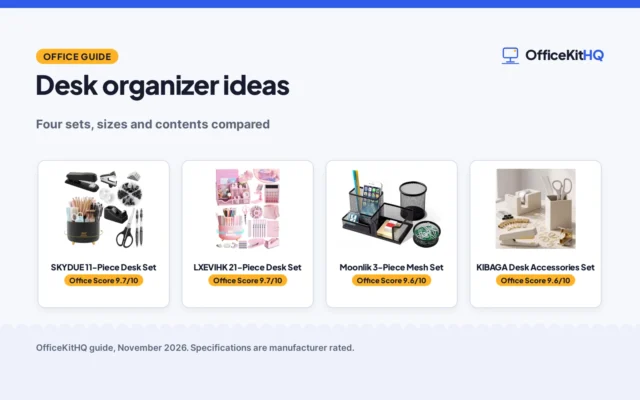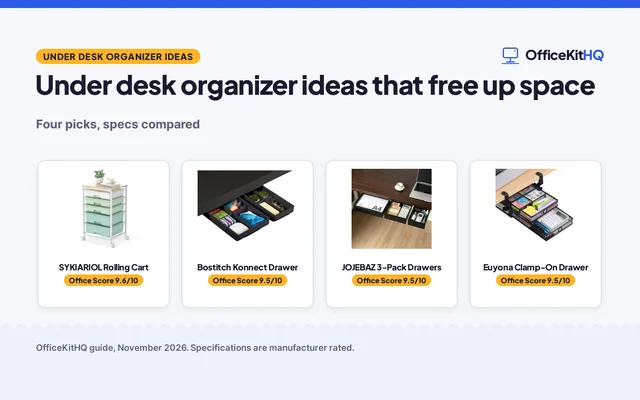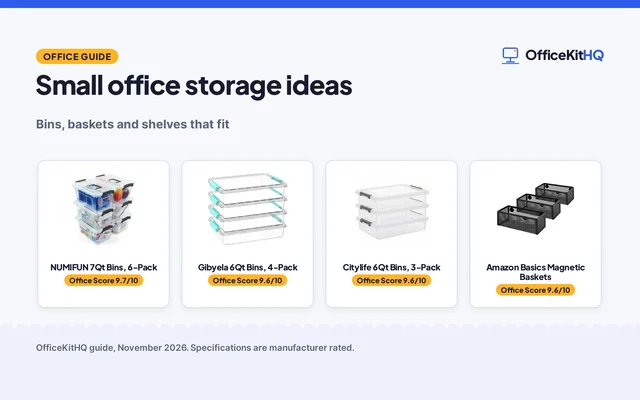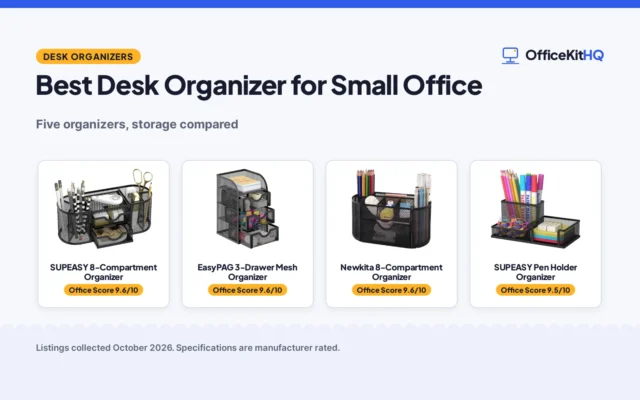
The call light blinks on while the webcam shows a dim corner of the room, the chair has sunk again by midday, and the laptop leans on a hub with cables trailing across a desk that already holds a notebook, a mug and a pile of papers that never got filed. Small desk organizer ideas start from that scene: give every small thing a home, keep paper off the surface, and leave enough clear space to actually work. This guide walks through the steps in order, using the figures a maker listing states for the tray it describes.
OfficeKitHQ earns a commission when you buy through links on this page, at no extra cost to you. As an Amazon Associate I earn from qualifying purchases. Affiliate disclosure.
The quick answer
Small desk organizer ideas work when the desk holds only what the day needs. A tray with four compartments takes the keys, wallet, phone and watch, papers stand upright in a file tray instead of lying in a stack, and cables run behind the desk instead of across it. The tray the listing describes measures 9.5 by 7.9 in, stands 1.0 in tall, and comes in seven colors, so it fits a small desk without crowding the work area. The rest of this guide turns that answer into steps: clear the surface, sort what stays, and set a short daily reset.
Small desk organizer ideas for a tiny desk
A tiny desk forgives nothing: every item left out takes space from the work itself. The ideas below all follow one rule, which is that each thing on the desk earns its place by being used daily, and everything else lives somewhere else. Start with the surface, then add one tray, then deal with paper and cables, and finish with a reset that takes less time than making a cup of tea.
Step 1: Empty the desk and sort what stays
Take everything off the desk and sort it into groups: used daily, used weekly, and hardly ever used. The daily group stays within reach, the weekly group goes in a drawer or on a shelf, and the hardly used group leaves the desk area altogether. A desk that holds only the daily group looks larger at once, and the sort shows which organizer the desk actually needs instead of which one looks nice in a photo. Keep the charger and the hub, since the laptop needs both, and move anything that has sat untouched for a season to a shelf.
Step 2: Give the small stuff a tray
Keys, coins, a wallet, a phone and a watch are the items that scatter across a small desk, and a tray with four compartments gives each of them a place. The Nordik By Design tray (on Amazon) the listing describes measures 9.5 by 7.9 in and stands 1.0 in tall, with four purpose-built compartments and a two-toned vegan leather finish in seven colors. Set the tray at the back corner of the desk, away from the mouse hand, and empty pockets into it when sitting down, so the small stuff stops migrating across the work surface. A desk organizer for a small office follows the same idea at a larger scale, while a mouse pad for a small desk marks the work zone and keeps the tray out of it.
Step 3: Move paper off the surface
Paper is what buries a small desk, because a stack grows flat and spreads. Stand current papers upright in a document file tray organizer at the back of the desk, file finished papers in a file box with a cover, and keep only the page in use on the surface. A tray that holds papers upright takes the footprint of a book instead of the footprint of a pile, and the page in hand stays easy to find. Anything that has not been touched since the last reset goes in the file box, not back on the desk.
Step 4: Tame the cables and keep a daily reset
Cables are the other part of desk clutter, and they tangle with everything a tray holds. Run the hub cable and the charger behind the desk, leave slack where the chair moves, and let the tray sit clear of the cable run so nothing snags when the tray is lifted. Finish the day with a short reset: papers back in the tray or the file box, small stuff back in its compartments, and the surface wiped clear. The reset works because the tray and the file box already have places for everything, so nothing needs a decision at the end of the day.
FAQ
What is the best way to organize a small desk?
Clear the surface, keep only daily items within reach, and give the small stuff a tray with compartments. Papers stand upright in a file tray, cables run behind the desk, and a short daily reset keeps the surface clear.
What size desk organizer fits a small desk?
One that leaves room to work. The tray the listing describes measures 9.5 by 7.9 in and stands 1.0 in tall, with four compartments for keys, a wallet, a phone and a watch, which suits a small desk without crowding the keyboard and mouse.
How do I keep a small desk tidy every day?
Reset the desk at the end of the day: papers back in the tray or the file box, small items back in their compartments, and cables tucked behind the desk. The reset stays short because everything already has a place.
Do I need a desk organizer if my desk is small?
A small desk needs one more than a large desk does, because every stray item takes a larger share of the surface. One tray with four compartments holds the small stuff in one place and leaves the rest of the desk free to work on.
More for your workspace
See the desk organizer for a small office, the mouse pad for a small desk, the file box with a cover and the document file tray organizer.