A morning call starts with a dim webcam and a mic that hums, and the best audio interface for pc is the box that cleans up the sound before the call starts. It sits between the microphone and the computer, turning the mic signal into a clean digital feed the PC can record. This guide compares USB interfaces by inputs, resolution, gain, monitoring, software and warranty, using only what each listing publishes.
OfficeKitHQ earns a commission when you buy through links on this page, at no extra cost to you. As an Amazon Associate I earn from qualifying purchases. Affiliate disclosure.
Quick picks
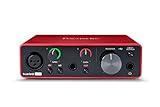 Best Overall Focusrite Scarlett Solo 3rd Gen: 1 XLR preamp, 24-bit/192kHz, 56dB gain range, Air mode Check price on Amazon
 Best 80dB Gain Elgato Wave XLR MK.2: 80dB gain, onboard voice effects, touch mute Check price on Amazon
 Best Loopback Piyone Q2: Loopback and monitor mix, 2 combo inputs, 48V phantom power Check price on Amazon
 Best Two Inputs M-AUDIO M-Track Duo: Two combo XLR/Line inputs, 48kHz, zero-latency monitoring Check price on Amazon
 Best Solo Input M-AUDIO M-Track Solo: One combo XLR input, 48kHz, stereo RCA outputs Check price on Amazon
Our desk picks
| # | Product | Office Score | Buy |
|---|---|---|---|
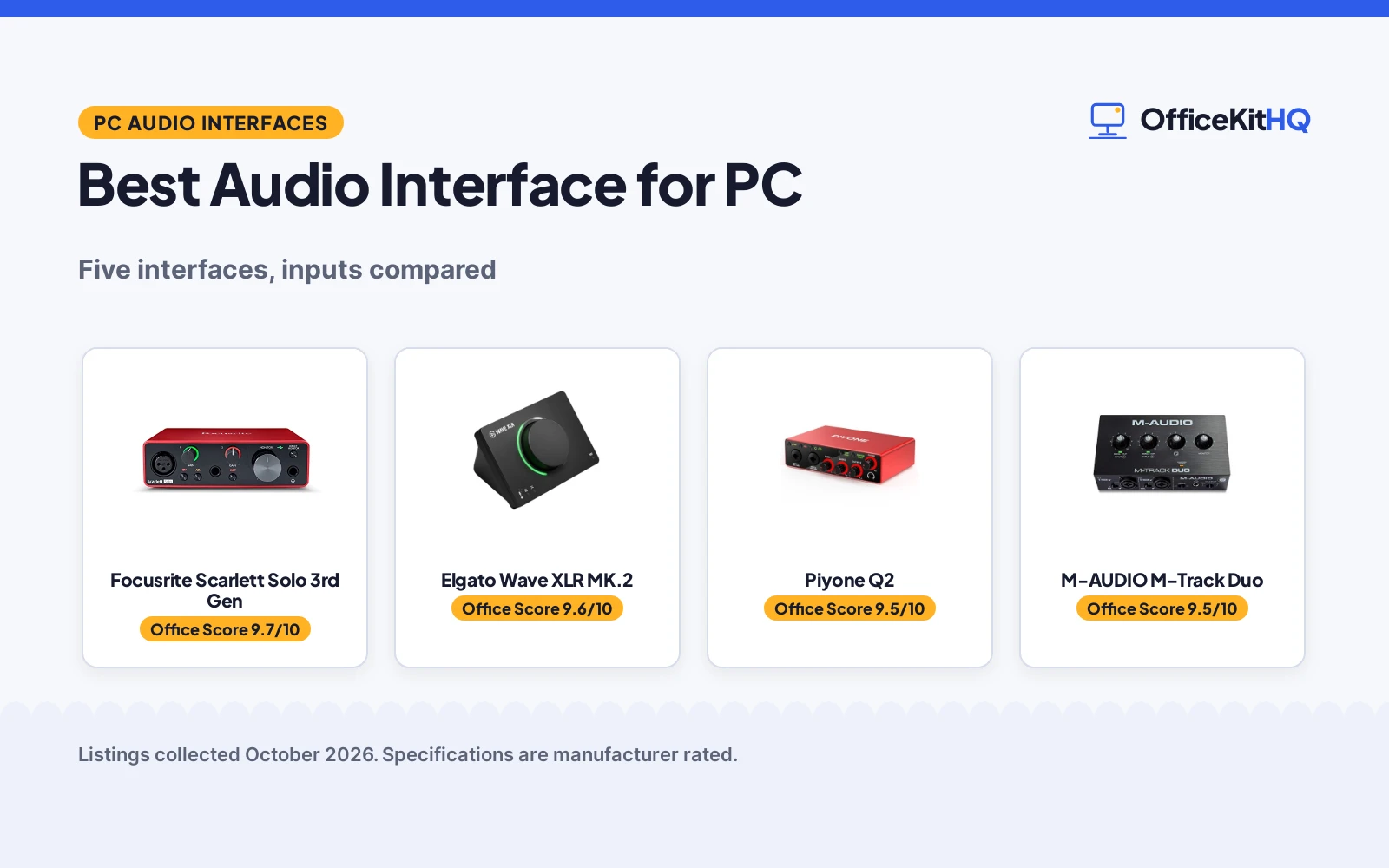
| 1 | Focusrite Scarlett Solo 3rd Gen | 9.7/10 | Buy on Amazon |
| 2 | Elgato Wave XLR MK.2 | 9.6/10 | Buy on Amazon |
| 3 | Piyone Q2 | 9.5/10 | Buy on Amazon |
| 4 | M-AUDIO M-Track Duo | 9.5/10 | Buy on Amazon |
| 5 | M-AUDIO M-Track Solo | 9.5/10 | Buy on Amazon |

Focusrite Scarlett Solo 3rd Gen
A one-input USB-C interface with a 24-bit/192kHz converter, a 56dB gain range and an Air mode for a solo mic or guitar.
Pros
- 24-bit/192kHz recording with a 56dB gain range
- Switchable Air mode for acoustic instruments
- Gain Halos warn before the input clips
- Includes Pro Tools Intro+, Ableton Live Lite and Cubase LE
Cons
- Bullets describe two instrument inputs against the one Hi-Z input in the title
- One XLR input, so another mic needs another interface
- No MIDI connection is stated
Detailed Review
Focusrite lists the Scarlett Solo 3rd Gen as a USB-C interface with one XLR mic preamp, one Hi-Z instrument input, 24-bit/192kHz converters and a 56dB gain range. The listing states a switchable Air mode, Gain Halos that warn before clipping, two low-noise balanced outputs and a headphone output for private listening. The listing contradicts itself twice: the title states one Hi-Z input while the bullets describe two high-headroom instrument inputs, and the bullets state a three-year warranty against the two-year warranty in the spec table.
Who it's for: a solo recorder who needs one mic and one guitar input with 24-bit/192kHz converters and a stated 3-year warranty. Who should skip it: anyone recording two mics at once, since this interface has one XLR input.
Its Office Score of 9.7/10 comes from performance 32/35, build 22/25, value 21/25, safety 5/10 and warranty 3/5: 83 of 100 points, placed on our 9.2 to 9.8 scale.
Key Specifications
| Inputs | 1 XLR, 1 Hi-Z |
|---|---|
| Resolution | 24-bit/192kHz |
| Gain range | 56dB |
| Weight | 0.77 lb |
Figures as published on the retailer listing, collected 10 November 2026. Performance figures are manufacturer rated.
Safety and Warranty
What this listing states. Gain Halos warn before the input clips, so safety scores 5 of 10. 3-year warranty stated in the listing. It does not say everything a buyer needs, such as who pays return shipping, so warranty scores 3 of 5. See How We Pick.
Protect your hearing. Keep volume moderate during long calls, take breaks, and treat noise cancelling and battery figures as the maker's claims.
This is general buying information, not professional advice. Follow each product manual and local rules, and see our Safety Disclaimer.

Elgato Wave XLR MK.2
An XLR interface with 80dB of gain, onboard voice effects and touch mute for a streaming or podcast desk.
Pros
- 80dB gain for any XLR microphone
- Onboard voice enhancer, compressor and EQ
- Touch mute with LED level feedback
- Works with Wave Link software and Stream Deck
Cons
- 24-bit/48kHz resolution, lower than the 192kHz picks here
- One XLR input, so another mic needs another interface
- No Hi-Z instrument input is stated
- No MIDI connection is stated
Detailed Review
Elgato lists the Wave XLR MK.2 as a USB audio interface and DSP mixer with 80dB of gain for any XLR microphone, 24-bit/48kHz resolution and ultra-low-latency monitoring. The listing states onboard voice effects with an enhancer, compressor and EQ, a touch mute with LED level feedback, and Wave Link software for routing and monitoring. The listing states a 2-year manufacturer warranty and a 0.71 lb body.
Who it's for: a streamer or podcaster who wants 80dB of gain, onboard voice effects and touch mute on one XLR input. Who should skip it: anyone recording two mics or an instrument, since this interface has one XLR input and no stated instrument input.
Its Office Score of 9.6/10 comes from performance 30/35, build 21/25, value 21/25, safety 4/10 and warranty 3/5: 79 of 100 points, placed on our 9.2 to 9.8 scale.
Key Specifications
| Inputs | 1 XLR |
|---|---|
| Resolution | 24-bit/48kHz |
| Gain | 80dB |
| Weight | 0.71 lb |
Figures as published on the retailer listing, collected 10 November 2026. Performance figures are manufacturer rated.
Safety and Warranty
What this listing states. LED level feedback shows input levels, so safety scores 4 of 10. 2-year manufacturer warranty stated. It does not say everything a buyer needs, such as who pays return shipping, so warranty scores 3 of 5. See How We Pick.
Protect your hearing. Keep volume moderate during long calls, take breaks, and treat noise cancelling and battery figures as the maker's claims.
This is general buying information, not professional advice. Follow each product manual and local rules, and see our Safety Disclaimer.

Piyone Q2
A two-input USB-C interface with 24-bit/192kHz converters, 48V phantom power and loopback for a PC recording desk.
Pros
- Two combo XLR/TRS inputs with 48V phantom power
- 24-bit/192kHz converters with zero-latency monitoring
- Monitor mix and loopback function
- 3.5mm headphone jack with no adapter needed
Cons
- 1.63 lb body, the heaviest of the five picks here
- No MIDI connection is stated
Detailed Review
Piyone lists the Q2 as a plug-and-play USB-C interface with two combo XLR/TRS inputs, 24-bit/192kHz converters, 48V phantom power and a Hi-Z input for guitar. The listing states a monitor mix and loopback function, direct monitoring with zero latency, a 3.5mm headphone jack and LED light rings on each gain knob. The listing contradicts itself: the spec table part number names Alloy Charcoal against the Alloy Red model, and the size field states 23.93 x 15.16 inches against the product dimensions in the same spec table.
Who it's for: a PC recorder who wants two combo inputs, 24-bit/192kHz converters and loopback on one USB-C cable. Who should skip it: anyone who wants a MIDI connection, since this listing states none.
Its Office Score of 9.5/10 comes from performance 29/35, build 20/25, value 20/25, safety 0/10 and warranty 3/5: 72 of 100 points, placed on our 9.2 to 9.8 scale.
Key Specifications
| Inputs | 2 combo XLR/TRS |
|---|---|
| Resolution | 24-bit/192kHz |
| Phantom power | 48V |
| Headphone | 3.5mm jack |
Figures as published on the retailer listing, collected 10 November 2026. Performance figures are manufacturer rated.
Safety and Warranty
What this listing states. No volume limit or safety listing is stated, so safety scores zero. 2-year limited warranty stated. It does not say everything a buyer needs, such as who pays return shipping, so warranty scores 3 of 5. See How We Pick.
Protect your hearing. Keep volume moderate during long calls, take breaks, and treat noise cancelling and battery figures as the maker's claims.
This is general buying information, not professional advice. Follow each product manual and local rules, and see our Safety Disclaimer.
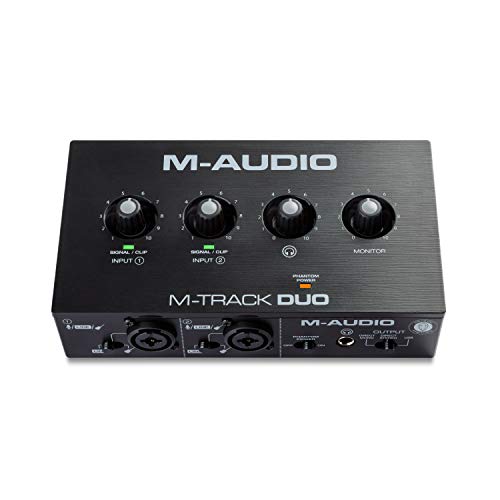
M-AUDIO M-Track Duo
A two-input USB interface with dual combo XLR inputs, 48kHz resolution and zero-latency monitoring for recording and streaming.
Pros
- Two combo XLR/Line/Instrument inputs with phantom power
- 1/4 inch headphone output and stereo 1/4 inch outputs
- USB/Direct switch for zero-latency monitoring
- Includes MPC Beats software from Akai Professional
Cons
- 48kHz resolution, lower than the 192kHz picks here
- 1-year warranty, tied for the lowest term here
- No MIDI connection is stated
- No gain figure is stated for the Crystal Preamps
Detailed Review
M-AUDIO lists the M-Track Duo as a USB interface with two combo XLR/Line/Instrument inputs with phantom power and 48kHz audio resolution. The listing states a 1/4 inch headphone output, stereo 1/4 inch outputs, a USB/Direct switch for zero-latency monitoring and MPC Beats software from Akai Professional. The listing states a 1-year manufacturer warranty and a 0.66 lb body.
Who it's for: a recorder who needs two mics or a mic and a guitar on one portable interface. Who should skip it: anyone who needs 192kHz resolution, since this interface records at 48kHz.
Its Office Score of 9.5/10 comes from performance 29/35, build 20/25, value 21/25, safety 0/10 and warranty 2/5: 72 of 100 points, placed on our 9.2 to 9.8 scale.
Key Specifications
| Inputs | 2 combo XLR/Line |
|---|---|
| Resolution | 48kHz |
| Headphone | 1/4 inch output |
| Weight | 0.66 lb |
Figures as published on the retailer listing, collected 10 November 2026. Performance figures are manufacturer rated.
Safety and Warranty
What this listing states. This product does not plug in or run on a battery, so safety is not part of its score. 1-year manufacturer warranty stated. It does not say everything a buyer needs, such as who pays return shipping, so warranty scores 2 of 5. See How We Pick.
Protect your hearing. Keep volume moderate during long calls, take breaks, and treat noise cancelling and battery figures as the maker's claims.
This is general buying information, not professional advice. Follow each product manual and local rules, and see our Safety Disclaimer.
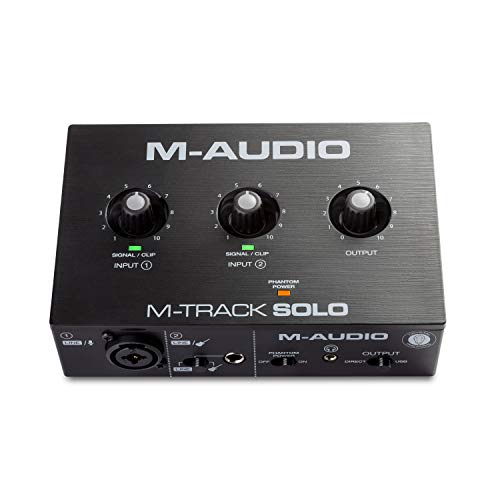
M-AUDIO M-Track Solo
A one-input USB interface with one combo XLR input, 48kHz resolution and stereo RCA outputs for recording, streaming and podcasting.
Pros
- One combo XLR/Line input with phantom power
- Stereo RCA outputs with a 1/8 inch headphone output
- USB/Direct switch for zero-latency monitoring
- Includes MPC Beats software from Akai Professional
Cons
- 48kHz resolution, lower than the 192kHz picks here
- 1-year warranty, tied for the lowest term here
- No MIDI connection is stated
- No gain figure is stated for the Crystal Preamp
Detailed Review
M-AUDIO lists the M-Track Solo as a USB interface with one combo XLR/Line input with phantom power, one Line/Instrument input and 48kHz audio resolution. The listing states a 1/8 inch headphone output, stereo RCA outputs, a USB/Direct switch for zero-latency monitoring and MPC Beats software from Akai Professional. The listing states a 1-year manufacturer warranty and a 0.6625 lb body.
Who it's for: a recorder or podcaster who needs one mic input and simple monitoring on a portable interface. Who should skip it: anyone recording two mics at once, since this interface has one combo XLR input.
Its Office Score of 9.5/10 comes from performance 28/35, build 20/25, value 20/25, safety 0/10 and warranty 2/5: 70 of 100 points, placed on our 9.2 to 9.8 scale.
Key Specifications
| Inputs | 1 combo XLR/Line |
|---|---|
| Resolution | 48kHz |
| Headphone | 1/8 inch output |
| Weight | 0.6625 lb |
Figures as published on the retailer listing, collected 10 November 2026. Performance figures are manufacturer rated.
Safety and Warranty
What this listing states. This product does not plug in or run on a battery, so safety is not part of its score. 1-year manufacturer warranty stated. It does not say everything a buyer needs, such as who pays return shipping, so warranty scores 2 of 5. See How We Pick.
Protect your hearing. Keep volume moderate during long calls, take breaks, and treat noise cancelling and battery figures as the maker's claims.
This is general buying information, not professional advice. Follow each product manual and local rules, and see our Safety Disclaimer.
As an Amazon Associate I earn from qualifying purchases.
More picks to compare
 Focusrite Scarlett 2i2 4th GenTwo mic preamps with Auto Gain and Clip Safe for a two-mic deskCheck on Amazon
 Focusrite Scarlett 2i2 StudioInterface plus mic and headphones for a complete first studioCheck on Amazon
 Universal Audio Volt 1Vintage 610 preamp mode for a one-mic recording deskCheck on Amazon
 MOTU M2Two preamps with hardware monitoring for a compact deskCheck on Amazon
 MAONO PS22 LiteLoopback and routing software for streaming and podcastingCheck on Amazon
Specs compared
| Audio interface | Office Score | Inputs | Resolution | Gain | Warranty | Amazon |
|---|---|---|---|---|---|---|
| Focusrite Scarlett Solo 3rd Gen | 9.7/10 | 1 XLR, 1 Hi-Z | 24-bit/192kHz | 56dB gain range | 3 years | View on Amazon |
| Elgato Wave XLR MK.2 | 9.6/10 | 1 XLR | 24-bit/48kHz | 80dB gain | 2 years | View on Amazon |
| Piyone Q2 | 9.5/10 | 2 combo XLR/TRS | 24-bit/192kHz | Not stated | 2 years | View on Amazon |
| M-AUDIO M-Track Duo | 9.5/10 | 2 combo XLR/Line | 48kHz | Not stated | 1 year | View on Amazon |
| M-AUDIO M-Track Solo | 9.5/10 | 1 combo XLR/Line | 48kHz | Not stated | 1 year | View on Amazon |
We quote these figures from each listing as the brand rates them; captured 10 November 2026. All five state a warranty term, and two state a level or clipping warning.
How to choose the best audio interface for pc
Count the inputs first
Count the XLR inputs before anything else, because that number decides how many mics record at once. The M-AUDIO M-Track Duo and the Piyone Q2 each list two combo inputs, so a mic and a guitar can record together. The Focusrite Scarlett Solo lists one XLR input and one Hi-Z input, the M-AUDIO M-Track Solo lists one combo input and one line input, and the Elgato Wave XLR MK.2 lists one XLR input. If the desk holds a mic and a guitar, pick a two-input interface; if it holds one mic, one input is enough. A mic that needs phantom power also needs an interface that lists 48V, and the two M-AUDIO interfaces and the Piyone list it. If the mic plugs in over USB instead of XLR, see the best USB microphone guide.
Match the resolution to the work
Resolution is the bit depth and sample rate the interface records at, and the listings here run at 24-bit/192kHz or 48kHz. The Focusrite Scarlett Solo and the Piyone Q2 list 24-bit/192kHz converters, while the Elgato Wave XLR MK.2 lists 24-bit/48kHz and the two M-AUDIO interfaces lists 48kHz audio resolution. A higher sample rate captures more detail per second, and a lower rate still covers speech and song for a podcast or a call. Check the resolution in the listing before you buy, and match it to the work the interface will do.
| Audio interface | Inputs | Resolution | Gain |
|---|---|---|---|
| Focusrite Scarlett Solo 3rd Gen | 1 XLR, 1 Hi-Z | 24-bit/192kHz | 56dB |
| Elgato Wave XLR MK.2 | 1 XLR | 24-bit/48kHz | 80dB |
| Piyone Q2 | 2 combo XLR/TRS | 24-bit/192kHz | Not stated |
| M-AUDIO M-Track Duo | 2 combo XLR/Line | 48kHz | Not stated |
| M-AUDIO M-Track Solo | 1 combo XLR/Line | 48kHz | Not stated |
Figures as stated in each listing. Gain is the boost the preamp adds to a microphone signal.
Gain, monitoring and loopback
Gain is the boost the preamp adds, and the two stated figures here are 56dB on the Focusrite Scarlett Solo and 80dB on the Elgato Wave XLR MK.2. The Piyone and the two M-AUDIO interfaces state no gain figure, so their preamps cannot be compared on that number. Monitoring matters as much as gain: the two M-AUDIO interfaces lists a USB/Direct switch for zero-latency monitoring, the Elgato lists ultra-low-latency monitoring, and the Piyone lists direct monitoring with zero latency. The Piyone also lists a monitor mix and loopback function, which routes computer audio back into the recording for a stream or a call.
Read the warranty line, not the headline
All five state a warranty term, but the terms run from 1 year to 3 years, and one listing contradicts itself. The Focusrite bullets state a three-year warranty while the spec table states a two-year warranty, so trust the bullets over the spec table. The Elgato and the Piyone state a 2-year warranty, and the two M-AUDIO interfaces states a 1-year manufacturer warranty. A longer term matters most on the interface that stays plugged in all day, so read the warranty line in the listing before you buy.
Check the outputs and the software
Outputs decide what the interface plugs into after the recording. The M-AUDIO M-Track Solo lists stereo RCA outputs and a 1/8 inch headphone output, the M-AUDIO M-Track Duo lists stereo 1/4 inch outputs and a 1/4 inch headphone output, and the Piyone lists a 3.5mm headphone jack. The Focusrite lists two low-noise balanced outputs and a headphone output for private listening. Software is named in the listings: the Focusrite includes Pro Tools Intro+, Ableton Live Lite and Cubase LE, the two M-AUDIO interfaces includes MPC Beats, and the Elgato works with Wave Link software. If the desk already has headphones, check the headphone jack size first: a best studio headphones wired guide lists the jacks those headphones use. For a card that sits inside the PC instead, see the best sound card for audio recording on PC guide. For a phone setup instead, see the best audio interface for phone guide.
FAQ
What is an audio interface?
An audio interface sits between a microphone or instrument and a computer, turning the analog signal into a digital feed the PC can record. All five picks here are USB interfaces for a PC desk, and each one lists at least one XLR input.
Do these audio interfaces have MIDI?
None of the five picks state a MIDI connection. If MIDI matters, check the listing for a MIDI port before you buy, since the interfaces here cover XLR, line and instrument inputs only.
What gain do I need for a microphone?
It depends on the mic, and the two stated figures here are 56dB on the Focusrite Scarlett Solo and 80dB on the Elgato Wave XLR MK.2. The Piyone and the two M-AUDIO interfaces state no gain figure, so their preamps cannot be compared on that number.
Does an audio interface work with a PC?
Yes. The Focusrite, M-AUDIO and Piyone listings state PC compatibility, and the Elgato works with Wave Link software. Check the operating system in the listing before you buy.
Which interface here has two inputs?
The M-AUDIO M-Track Duo and the Piyone Q2 each list two combo inputs. The Focusrite Scarlett Solo lists one XLR input and one Hi-Z input, and the M-AUDIO M-Track Solo lists one combo input and one line input.
Score breakdown
The Office Score weighs performance (inputs, resolution, gain and monitoring), build (construction and controls), value for the stated specs, safety and warranty. For an audio interface, safety means stated protections such as clipping warnings and level feedback; the Focusrite states Gain Halos and the Elgato states LED level feedback. All five state a warranty term: the Focusrite at 3 years, the Elgato and Piyone at 2 years, and the two M-AUDIO interfaces at 1 year. How we pick explains the weights.
| Product | Office Score | Perf. /35 | Build /25 | Value /25 | Safety /10 | Warranty /5 |
|---|---|---|---|---|---|---|
| Focusrite Scarlett Solo 3rd Gen | 9.7 | 32 | 22 | 21 | 5 | 3 |
| Elgato Wave XLR MK.2 | 9.6 | 30 | 21 | 21 | 4 | 3 |
| Piyone Q2 | 9.5 | 29 | 20 | 20 | 0 | 3 |
| M-AUDIO M-Track Duo | 9.5 | 29 | 20 | 21 | 0 | 2 |
| M-AUDIO M-Track Solo | 9.5 | 28 | 20 | 20 | 0 | 2 |
Score placement follows the weighted total: the lowest totals read 9.2, the highest 9.8, and everything between keeps its order.
More for your workspace
See every audio, power and connectivity guide and all office guides guides.
More picks: types of audio cables, USB-C cable types, best microphone isolation shield and best boom arm microphone for home studio.