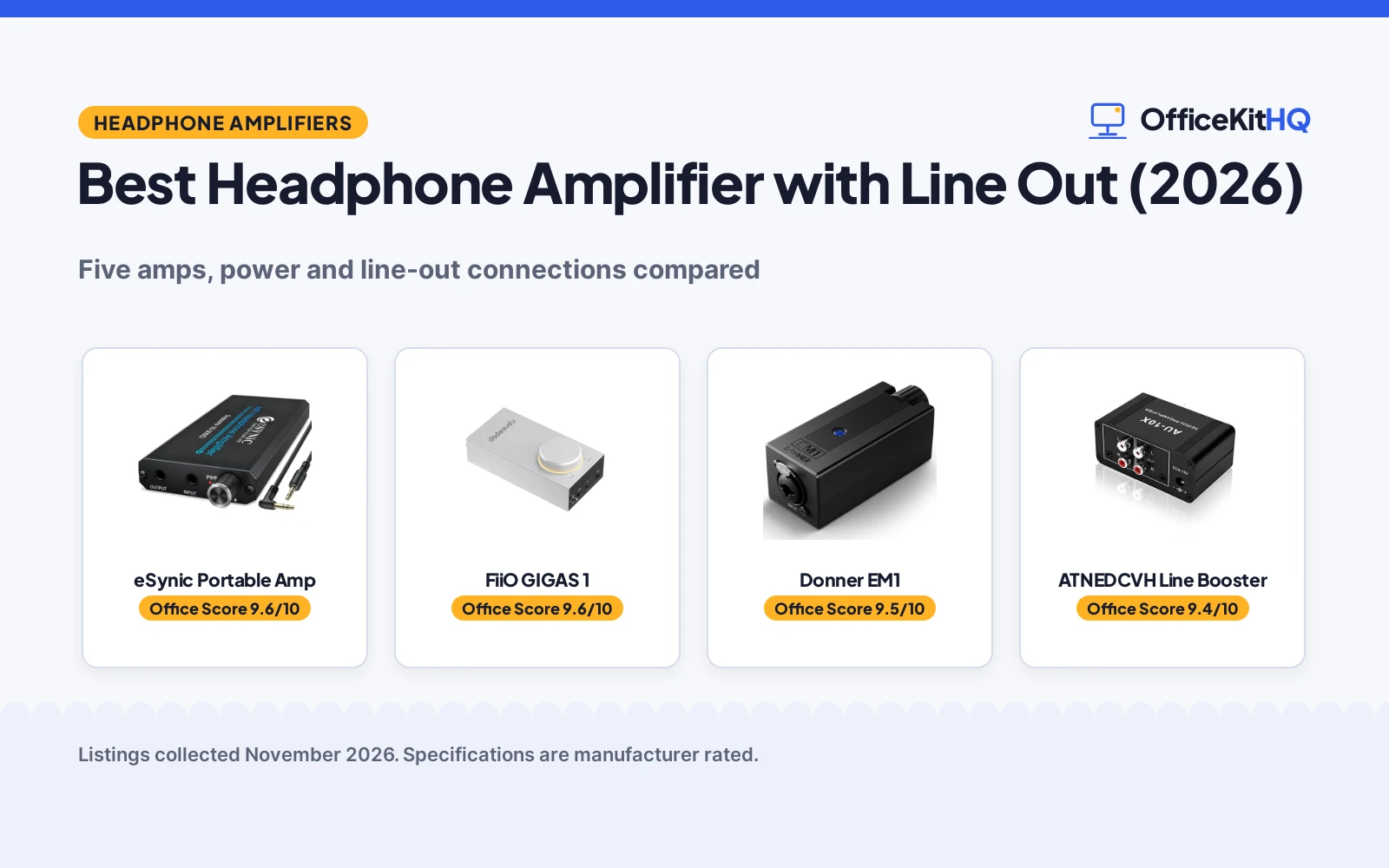
The best headphone amplifier with line out earns its place between the source and the headphones, when the laptop jack sounds thin and the headphones you already own never get loud enough. It takes a weak line-level signal, gives it gain, and hands it to the headphones without adding hiss. We compared five amplifiers by output power, impedance range, inputs and outputs, battery life and stated warranty, using only what each listing publishes.
OfficeKitHQ earns a commission when you buy through links on this page, at no extra cost to you. As an Amazon Associate I earn from qualifying purchases. Affiliate disclosure.
Quick picks
 Best Overall eSynic Portable Amp: 16 to 300 ohms, 12-plus hours, 18-month warranty Check price on Amazon
 Best Desktop Power FiiO GIGAS 1: 4600 mW plus 4600 mW balanced, Class AB discrete Check price on Amazon
 Best In-Ear Monitor Donner EM1: XLR and TRS input, 12 hours, belt-pack clip Check price on Amazon
 Best Line-Level Booster ATNEDCVH Line Booster: 20 dB gain, RCA and 3.5 mm in and out Check price on Amazon
 Best RCA Preamp KH866 RCA Preamp: 20 dB gain, RCA in to 3.5 mm out, 2-month warranty Check price on Amazon
Our desk picks
| # | Product | Office Score | Buy |
|---|---|---|---|
| 1 | eSynic Portable Amp | 9.6/10 | Buy on Amazon |
| 2 | FiiO GIGAS 1 | 9.6/10 | Buy on Amazon |
| 3 | Donner EM1 | 9.5/10 | Buy on Amazon |
| 4 | ATNEDCVH Line Booster | 9.4/10 | Buy on Amazon |
| 5 | KH866 RCA Preamp | 9.3/10 | Buy on Amazon |

eSynic Portable Amp
A rechargeable portable headphone amplifier with a 16 to 300 ohm range, 2-stage gain, 30 mW into 16 ohms and 12-plus hours of playtime.
Pros
- 16 to 300 ohm range with a 2-stage gain switch
- 30 mW into 16 ohms and 15 mW into 300 ohms
- 12-plus hours of playtime on a 2 to 3 hour charge
- 18-month warranty stated in the spec table
Cons
- No RCA input or output is stated
- 3.5 mm only, with no balanced output stated
- Smallest stated power here at 30 mW into 16 ohms
Detailed Review
eSynic lists a rechargeable portable headphone amplifier with a 16 to 300 ohm range, a 2-stage gain switch and volume control in an aluminum alloy housing. It states 30 mW into 16 ohms and 15 mW into 300 ohms, with SNR above 100 dB and THD+N as low as 0.0003%. The 3.5 mm input and output suit phones, laptops, consoles and CD players, and the battery gives 12-plus hours on a 2 to 3 hour charge, with 12 cm and 100 cm audio cables included. One contradiction: the spec table lists dimensions of 6.5 by 4.0 by 0.8 in while the bullets state a 95 by 52 by 13 mm profile, so trust the bullets for the size.
Who it's for: a listener with 250 to 300 ohm headphones, or anyone who wants a pocket amp for a phone or laptop. Who should skip it: anyone who needs RCA or balanced connections, or a desktop amp that runs on wall power.
Its Office Score of 9.6/10 comes from performance 30/35, build 21/25, value 21/25, safety 5/10 and warranty 3/5: 80 of 100 points, placed on our 9.2 to 9.8 scale.
Key Specifications
| Impedance | 16 to 300 ohms |
|---|---|
| Output | 30 mW into 16 ohms |
| Battery | 12-plus hours |
| Warranty | 18 months |
Figures as published on the retailer listing, collected 12 November 2026. Performance figures are manufacturer rated.
Safety and Warranty
What this listing states. 2-stage gain matches low or high impedance headphones, so safety scores 5 of 10. 18-month warranty. It does not say everything a buyer needs, such as who pays return shipping, so warranty scores 3 of 5. See How We Pick.
Protect your hearing. Keep volume moderate during long calls, take breaks, and treat noise cancelling and battery figures as the maker's claims.
This is general buying information, not professional advice. Follow each product manual and local rules, and see our Safety Disclaimer.

FiiO GIGAS 1
A desktop headphone amplifier with Class AB discrete amplification, up to 4600 mW plus 4600 mW balanced output, and 4.4 mm and 3.5 mm outputs.
Pros
- 4600 mW plus 4600 mW balanced output at 32 ohms
- Class AB discrete amplification with ON Semiconductor transistor pairs
- 4.4 mm balanced and 3.5 mm outputs, with CTIA mic pass-through on the 3.5 mm
- Dual gain modes for sensitive IEMs and power-hungry headphones
Cons
- No impedance range is stated
- No battery; needs 5V USB or 12V PD power
- No line out is stated, only headphone outputs
- 3.5 mm-to-USB-C cable bundle is optional, not included
Detailed Review
FiiO lists the JadeAudio GIGAS 1 as a desktop headphone amplifier with Class AB discrete amplification built on ON Semiconductor MJE243G and MJE253G transistor pairs. It delivers 4600 mW plus 4600 mW through the 4.4 mm balanced output at 32 ohms, and offers a 3.5 mm single-ended output with CTIA microphone pass-through. RCA and 3.5 mm inputs take DACs, smartphones, computers and CD players, and dual gain modes match sensitive IEMs and power-hungry headphones. It runs on 5V USB or 12V PD, and the spec table states a 1-year warranty.
Who it's for: a desktop listener with planar magnetic or high-impedance headphones who wants balanced power. Who should skip it: anyone who needs a battery, a stated line out, or a stated impedance range.
Its Office Score of 9.6/10 comes from performance 33/35, build 21/25, value 20/25, safety 5/10 and warranty 2/5: 81 of 100 points, placed on our 9.2 to 9.8 scale.
Key Specifications
| Output | 4600 mW plus 4600 mW balanced |
|---|---|
| Class | AB discrete |
| Outputs | 4.4 mm balanced, 3.5 mm |
| Power | 5V USB or 12V PD |
Figures as published on the retailer listing, collected 12 November 2026. Performance figures are manufacturer rated.
Safety and Warranty
What this listing states. Dual gain modes match sensitive IEMs and power-hungry headphones, so safety scores 5 of 10. 1-year warranty. It does not say everything a buyer needs, such as who pays return shipping, so warranty scores 2 of 5. See How We Pick.
Protect your hearing. Keep volume moderate during long calls, take breaks, and treat noise cancelling and battery figures as the maker's claims.
This is general buying information, not professional advice. Follow each product manual and local rules, and see our Safety Disclaimer.

Donner EM1
A portable analog headphone amplifier with XLR and TRS input, a 3.5 mm output jack and up to 12 hours on a single charge.
Pros
- XLR and TRS input with a locking mechanism
- Stereo and mono source switch for in-ear and on-ear monitors
- Runs up to 12 hours on a single charge
- Belt-pack clip and compact metal build for carrying
Cons
- No impedance range is stated
- No output power figure is stated
- Does not support a microphone
- No RCA input or output is stated
Detailed Review
Donner lists the EM1 as a portable analog headphone amplifier for high-impedance professional headphones, with XLR and TRS input connectors and a locking mechanism, a stereo and mono source switch, and a 3.5 mm output jack. It runs up to 12 hours on a single charge from a Li-ion battery, with LED indicators for power and charging and a solid metallic belt-pack clip. The listing states it does not support a microphone, and the spec table states a 1-year warranty.
Who it's for: a performer or monitor user who needs XLR and TRS input in a belt-pack amp. Who should skip it: anyone who needs a stated impedance range, a stated power figure, or microphone support.
Its Office Score of 9.5/10 comes from performance 28/35, build 20/25, value 20/25, safety 0/10 and warranty 2/5: 70 of 100 points, placed on our 9.2 to 9.8 scale.
Key Specifications
| Inputs | XLR and TRS |
|---|---|
| Output | 3.5 mm jack |
| Battery | Up to 12 hours |
| Warranty | 1 year |
Figures as published on the retailer listing, collected 12 November 2026. Performance figures are manufacturer rated.
Safety and Warranty
What this listing states. No volume limit or safety listing is stated, so safety scores zero. 1-year warranty. It does not say everything a buyer needs, such as who pays return shipping, so warranty scores 2 of 5. See How We Pick.
Protect your hearing. Keep volume moderate during long calls, take breaks, and treat noise cancelling and battery figures as the maker's claims.
This is general buying information, not professional advice. Follow each product manual and local rules, and see our Safety Disclaimer.
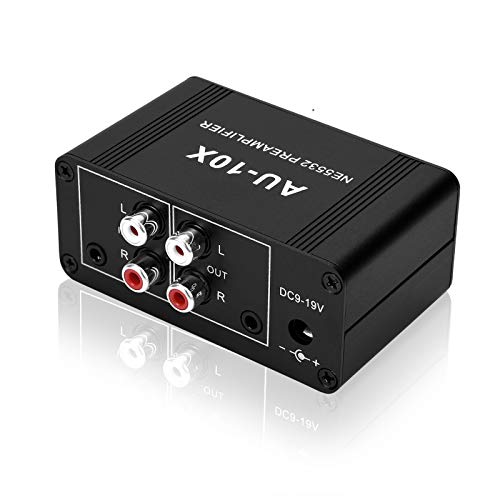
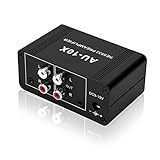
ATNEDCVH Line Booster
A mini line-level booster with 20 dB of gain, dual NE5532 op-amps, and RCA and 3.5 mm inputs and outputs with a headphone jack.
Pros
- 20 dB gain, or 10x, for weak line-level signals
- RCA and 3.5 mm inputs and outputs
- Dedicated 3.5 mm headphone jack with its own volume knob
- Compact metal housing at 3.42 by 1.96 by 1.45 in
Cons
- No warranty term is stated
- Headphone jack drives headphones up to 16 ohms only
- Not a phono stage; raw phono-level turntables are not compatible
- Cannot drive passive speakers directly
Detailed Review
ATNEDCVH lists a mini audio preamplifier that boosts weak line-level signals by 20 dB, or 10x, using dual NE5532 op-amps with a noise-reduction circuit. It takes RCA and 3.5 mm inputs and gives RCA and 3.5 mm outputs, plus a dedicated 3.5 mm headphone jack with an independent volume knob that drives headphones up to 16 ohms. It works with turntables that have a built-in phono preamp and a line out, and not with raw phono-level turntables. One contradiction: the spec table lists dimensions of 3.43 by 3.43 by 1.46 in while the bullets state 3.42 by 1.96 by 1.45 in, so trust the bullets for the size. A DC 9 to 19 V power adapter is included.
Who it's for: a listener boosting a quiet phone, TV or turntable with a built-in preamp before an amplifier or active speakers. Who should skip it: anyone with a raw phono turntable, headphones above 16 ohms, or anyone who wants a warranty term.
Its Office Score of 9.4/10 comes from performance 27/35, build 19/25, value 19/25, safety 0/10 and warranty 0/5: 65 of 100 points, placed on our 9.2 to 9.8 scale.
Key Specifications
| Gain | 20 dB, 10x |
|---|---|
| Op-amp | Dual NE5532 |
| Inputs and outputs | RCA and 3.5 mm |
| Size | 3.42 by 1.96 by 1.45 in |
Figures as published on the retailer listing, collected 12 November 2026. Performance figures are manufacturer rated.
Safety and Warranty
What this listing states. This product does not plug in or run on a battery, so safety is not part of its score. No warranty term, so warranty scores zero. See How We Pick.
Protect your hearing. Keep volume moderate during long calls, take breaks, and treat noise cancelling and battery figures as the maker's claims.
This is general buying information, not professional advice. Follow each product manual and local rules, and see our Safety Disclaimer.

KH866 RCA Preamp
A 12V RCA preamplifier with 20 dB of gain, dual NE5532 op-amps, RCA and 3.5 mm inputs, and a 3.5 mm headphone output.
Pros
- 20 dB gain for weak turntable and line signals
- RCA and 3.5 mm inputs with a 3.5 mm output
- Headphone output is separate from the other ports
- 2-month warranty stated in the spec table
Cons
- Headphone output supports a maximum of 16 ohms
- No dimensions are stated in the listing
- 2-month warranty is the smallest term stated here
- Cannot be used as a power amplifier for passive speakers
Detailed Review
KH866 lists a 12V RCA preamplifier with 20 dB of gain built on a dual NE5532 circuit, with RCA and 3.5 mm inputs and a 3.5 mm output. The headphone output drives headphones for playback, supports a maximum impedance of 16 ohms, and is not shared with the other ports. Volume is freely adjustable, and the unit runs on DC 9 to 19 V. It cannot be used as a power amplifier for passive speakers, and the spec table states a 2-month warranty. No dimensions are stated anywhere in the listing.
Who it's for: a turntable or line-source listener who wants a compact 20 dB boost with a separate headphone output. Who should skip it: anyone with headphones above 16 ohms, anyone who needs stated dimensions, or anyone who wants a longer warranty.
Its Office Score of 9.3/10 comes from performance 26/35, build 18/25, value 18/25, safety 0/10 and warranty 1/5: 63 of 100 points, placed on our 9.2 to 9.8 scale.
Key Specifications
| Gain | 20 dB |
|---|---|
| Op-amp | Dual NE5532 |
| Inputs | RCA and 3.5 mm |
| Power | DC 9 to 19 V |
Figures as published on the retailer listing, collected 12 November 2026. Performance figures are manufacturer rated.
Safety and Warranty
What this listing states. No volume limit or safety listing is stated, so safety scores zero. 2-month warranty. It does not say everything a buyer needs, such as who pays return shipping, so warranty scores 1 of 5. See How We Pick.
Protect your hearing. Keep volume moderate during long calls, take breaks, and treat noise cancelling and battery figures as the maker's claims.
This is general buying information, not professional advice. Follow each product manual and local rules, and see our Safety Disclaimer.
As an Amazon Associate I earn from qualifying purchases.
More picks to compare
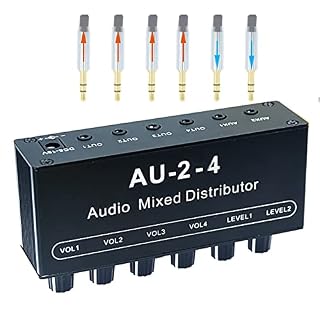 Arklove 2-In 4-Out Amp2-in, 4-out headset box so 4 people can listen at onceCheck on Amazon
 Fosi Audio PH05 Splitter5-channel splitter amp with independent volume on each channelCheck on Amazon
 RuiPuo Portable AmpPortable amp with a gain switch and 15 hours of batteryCheck on Amazon
 Khadas Tone2 ProDAC and headphone amp with a balanced RCA line-outCheck on Amazon
Specs compared
| Amplifier | Office Score | Output or gain | Impedance range | Inputs and outputs | Battery | Warranty | Amazon |
|---|---|---|---|---|---|---|---|
| eSynic Portable Amp | 9.6/10 | 30 mW into 16 ohms | 16 to 300 ohms | 3.5 mm in and out | 12-plus hours | 18 months | View on Amazon |
| FiiO GIGAS 1 | 9.6/10 | 4600 mW plus 4600 mW balanced | Not stated | RCA and 3.5 mm in; 4.4 mm and 3.5 mm out | Not stated | 1 year | View on Amazon |
| Donner EM1 | 9.5/10 | Not stated | Not stated | XLR and TRS in; 3.5 mm out | Up to 12 hours | 1 year | View on Amazon |
| ATNEDCVH Line Booster | 9.4/10 | 20 dB gain | Up to 16 ohms | RCA and 3.5 mm in and out | Not stated | Not stated | View on Amazon |
| KH866 RCA Preamp | 9.3/10 | 20 dB gain | Up to 16 ohms | RCA and 3.5 mm in; 3.5 mm out | Not stated | 2 months | View on Amazon |
Specs reflect manufacturer claims on each product listing (as of 12 November 2026). Four of the five state a warranty term.
How to choose the best headphone amplifier with line out
Start with the impedance range
Impedance decides whether an amp can drive your headphones at all. The eSynic states a 16 to 300 ohm range with a 2-stage gain switch: low gain for 16 to 80 ohms and high gain for 80 to 300 ohms, with 15 mW into 300 ohms. The FiiO is built for planar magnetic and high-impedance headphones but states no range. The ATNEDCVH and KH866 drive headphones up to 16 ohms only, and the Donner is built for high-impedance professional headphones with no range stated.
Line out, headphone out, or both
A line out feeds another amplifier or active speakers, while a headphone out drives the headphones directly. The ATNEDCVH is the clearest line-level box here: RCA and 3.5 mm inputs and outputs, built to boost a weak line-level signal, and it works with turntables that have a built-in phono preamp and a line out. The eSynic gives a 3.5 mm input and output, the FiiO gives RCA and 3.5 mm inputs with 4.4 mm and 3.5 mm headphone outputs, the Donner takes XLR and TRS input to a 3.5 mm output jack, and the KH866 takes RCA input to a 3.5 mm output. For the cables between the boxes, see the aux cable for high quality audio guide.
Power, battery and where it sits
Output power runs from 4600 mW plus 4600 mW balanced on the FiiO down to 30 mW into 16 ohms on the eSynic, while the Donner states no power figure and the two preamps state 20 dB of gain instead. The two portable models run on battery: the eSynic for 12-plus hours on a 2 to 3 hour charge, and the Donner for up to 12 hours on a single charge. The FiiO runs on 5V USB or 12V PD power, and the ATNEDCVH and KH866 run on DC 9 to 19 V adapters.
| Amplifier | Output or gain | Battery | Warranty |
|---|---|---|---|
| eSynic Portable Amp | 30 mW into 16 ohms | 12-plus hours | 18 months |
| FiiO GIGAS 1 | 4600 mW plus 4600 mW balanced | Not stated | 1 year |
| Donner EM1 | Not stated | Up to 12 hours | 1 year |
| ATNEDCVH Line Booster | 20 dB gain | Not stated | Not stated |
| KH866 RCA Preamp | 20 dB gain | Not stated | 2 months |
Figures as stated in each listing.
Gain switches and volume knobs
Gain matching keeps a sensitive earphone from getting too much power and a demanding headphone from getting too little. The eSynic uses a 2-stage gain switch plus volume control, and the FiiO uses dual gain modes for sensitive IEMs and power-hungry headphones. The ATNEDCVH gives a dedicated headphone jack with its own volume knob, the KH866 gives freely adjustable volume control, and the Donner gives volume control with LED indicators. A gain switch matters most when one amp serves both earphones and full-size headphones.
Read the warranty line, not the headline
The terms run from 18 months down to 2 months: the eSynic states 18 months, the FiiO and Donner state 1 year each, and the KH866 states 2 months. The ATNEDCVH states no warranty term at all. A short term is still a term in writing, so weigh the months beside the power figures before choosing.
FAQ
What does a headphone amplifier do?
It raises a weak line-level signal to a level that drives headphones properly. The ATNEDCVH and KH866 each list 20 dB of gain for that job.
Which amplifier here drives 300-ohm headphones?
The eSynic, which states a 16 to 300 ohm range with 15 mW into 300 ohms.
Can I use these with a turntable?
Only the ATNEDCVH: it works with turntables that have a built-in phono preamp and a line out, and not with raw phono-level turntables.
Which amplifiers run on battery?
The eSynic and the Donner. The eSynic gives 12-plus hours on a 2 to 3 hour charge, and the Donner runs up to 12 hours on a single charge.
Which amplifier has the highest stated output?
The FiiO GIGAS 1, at 4600 mW plus 4600 mW through the 4.4 mm balanced output at 32 ohms.
Score breakdown
The Office Score weighs performance (output power, impedance range, gain and stated inputs and outputs), build (housing material, amplifier class or op-amp and stated weight), value for the stated specs, safety and warranty. For a headphone amplifier, safety means gain modes that match sensitive earphones as well as power-hungry headphones; the eSynic and FiiO state them, the other three do not. Four listings state a warranty term: the eSynic at 18 months, the FiiO and Donner at 1 year each, and the KH866 at 2 months. How we pick explains the weights.
| Product | Office Score | Perf. /35 | Build /25 | Value /25 | Safety /10 | Warranty /5 |
|---|---|---|---|---|---|---|
| eSynic Portable Amp | 9.6 | 30 | 21 | 21 | 5 | 3 |
| FiiO GIGAS 1 | 9.6 | 33 | 21 | 20 | 5 | 2 |
| Donner EM1 | 9.5 | 28 | 20 | 20 | 0 | 2 |
| ATNEDCVH Line Booster | 9.4 | 27 | 19 | 19 | 0 | 0 |
| KH866 RCA Preamp | 9.3 | 26 | 18 | 18 | 0 | 1 |
The scale opens at 9.2 and closes at 9.8; between those marks, weighted points translate linearly into the score you see.
More for your workspace
See every headsets guide and all audio, power and connectivity guides. Also see our headset for mic quality, audio interface for PC, Bluetooth receiver for headphones, computer speakers with headphone jack and audio jack sizes.
More picks: Bluetooth headset for gaming, computer speakers for work from home, docking stations and USB hubs.