The best microphone preamp for live vocals is the one that lifts a quiet dynamic mic to a usable level without adding hiss, and the search usually starts at a home desk when the interface gain is already maxed and the vocal still sits low in the mix. This article compares five microphone preamps by stated gain, channel count, phantom power, inputs and warranty term, using only what each listing publishes. Gain separates the group most: two preamps state 25dB, one states 10 to 60dB, one states up to +60dB, and one states no gain figure. Channel count runs from single-channel to three channels, and phantom power is either built in or borrowed from the interface.
OfficeKitHQ earns a commission when you buy through links on this page, at no extra cost to you. As an Amazon Associate I earn from qualifying purchases. Affiliate disclosure.
Quick picks
 Best Overall Rodyweil Two Channel: 25dB gain, two channels, 5-year warranty stated Check price on Amazon
 Best Tube Preamp Behringer MIC300: Tube preamp with output limiter for condenser mics Check price on Amazon
 Widest Gain Range ASHATA Mic Preamp: 10 to 60dB gain, 3 channel input, 90-day warranty Check price on Amazon
 Best for Live Vocals Coda MB-1: 25dB gain, -70dB noise floor, built for live sound Check price on Amazon
Our desk picks
| # | Product | Office Score | Buy |
|---|---|---|---|
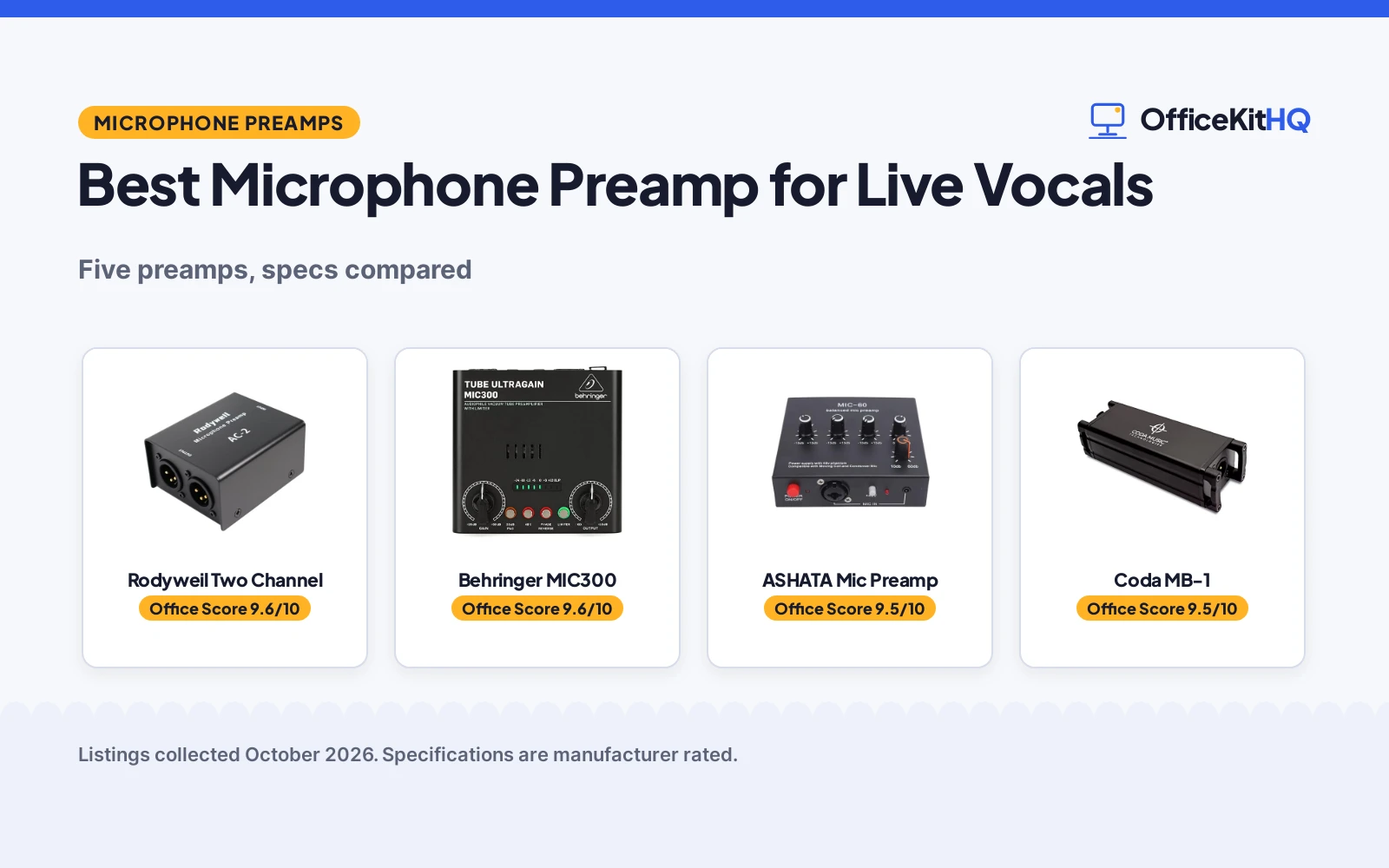
| 1 | Rodyweil Two Channel | 9.6/10 | Buy on Amazon |
| 2 | Behringer MIC300 | 9.6/10 | Buy on Amazon |
| 3 | ASHATA Mic Preamp | 9.5/10 | Buy on Amazon |
| 4 | Coda MB-1 | 9.5/10 | Buy on Amazon |
| 5 |  Denash Mic Preamp | 9.4/10 | Buy on Amazon |

Rodyweil Two Channel
A two-channel preamp with 25dB of gain and a stated 5-year warranty for dynamic and ribbon mics.
Pros
- 25dB of gain lifts dynamic mics like the SM58 and SM7B to -18 to -10 dB output level.
- Two channels in one unit, with single-channel and four-channel versions also sold.
- Runs on 48V phantom power from the interface or mixer, with no additional power supply.
- 5-year warranty is stated.
Cons
- States 25dB of gain with no stated adjustment range.
- Needs 48V phantom power from the interface or mixer; it supplies none itself.
- Two channels only; four-channel use calls for a different version.
- Dynamic and ribbon mics are the named uses; condenser mic use is not stated.
Detailed Review
The Rodyweil is a two-channel preamp that adds 25dB of gain and states it can lift dynamic microphones like the SM58 and SM7B to a normal output level of -18 to -10 dB. It runs on 48V phantom power from the audio interface or mixer, with no additional power supply, and the maker states the interface preamp only needs to be set to 50% instead of maximum. The model is also sold in single-channel and four-channel versions, and a 5-year warranty is stated.
Who it's for: singers and streamers who run two dynamic or ribbon mics from one interface and want a 5-year warranty. Who should skip it: buyers whose mic is a condenser, since the listing names dynamic and ribbon mics only.
Its Office Score of 9.6/10 comes from performance 30/35, build 21/25, value 21/25, safety 0/10 and warranty 4/5: 76 of 100 points, placed on our 9.2 to 9.8 scale.
Key Specifications
| Gain | 25dB |
|---|---|
| Channels | Two |
| Output level | -18 to -10 dB |
| Warranty | 5 years |
These specs mirror the retailer listing as of 21 November 2026; performance figures are stated by the brand.
Safety and Warranty
What this listing states. This product does not plug in or run on a battery, so safety is not part of its score. 5-year warranty. It does not say everything a buyer needs, such as who pays return shipping, so warranty scores 4 of 5. See How We Pick.
Protect your hearing. Keep volume moderate during long calls, take breaks, and treat noise cancelling and battery figures as the maker's claims.
This is general buying information, not professional advice. Follow each product manual and local rules, and see our Safety Disclaimer.

Behringer MIC300
A single-channel tube preamp with a limiter for condenser mics, instruments and line-level sources.
Pros
- Tube preamplifier with an output limiter that prevents clipping.
- Designed for studio-grade condenser microphones.
- Handles microphone, instrument and line-level sources.
- Stated to match studio or live recording setups.
Cons
- Single-channel input suits one source at a time.
- No gain figure is stated.
- No phantom power figure is stated for its condenser mic use.
- No warranty term is stated.
Detailed Review
The Behringer MIC300 is a single-channel tube microphone and instrument preamplifier with a limiter, stated to match studio or live recording setups. It is designed for studio-grade condenser mics and also handles instrument and line-level sources, and the output limiter prevents the output signal from clipping. No gain figure and no warranty term are stated.
Who it's for: vocalists and players who want a tube preamp with a limiter for one condenser mic, instrument or line source. Who should skip it: buyers who need a stated gain figure, a warranty term or more than one channel.
Its Office Score of 9.6/10 comes from performance 30/35, build 22/25, value 20/25, safety 7/10 and warranty 0/5: 79 of 100 points, placed on our 9.2 to 9.8 scale.
Key Specifications
| Type | Tube preamplifier with limiter |
|---|---|
| Channels | Single-channel |
| Sources | Microphone, instrument and line-level |
| Limiter | Output limiter stated |
These specs mirror the retailer listing as of 21 November 2026; performance figures are stated by the brand.
Safety and Warranty
What this listing states. Output limiter prevents the output signal from clipping, so safety scores 7 of 10. No warranty term, so warranty scores zero. See How We Pick.
Protect your hearing. Keep volume moderate during long calls, take breaks, and treat noise cancelling and battery figures as the maker's claims.
This is general buying information, not professional advice. Follow each product manual and local rules, and see our Safety Disclaimer.

ASHATA Mic Preamp
A three-channel preamp with 10 to 60dB of gain and built-in 48V power for condenser and dynamic mics.
Pros
- Gain range of 10 to 60dB.
- 3 channel input handles condenser and dynamic microphones at once.
- Balanced XLR plus 6.35mm and 3.5mm inputs and outputs.
- Robust black metal casing reduces most interference.
Cons
- 3.5mm and 6.35mm connections are unbalanced when used as inputs.
- Manufacturer warranty runs 90 days, shorter than the Rodyweil 5-year term.
- No noise figure is stated.
- No dimensions or weight are stated.
Detailed Review
The ASHATA preamp states a gain boost from 10 to 60dB with a fully balanced circuit design, and it carries a 48V power supply with a 3 channel input for condenser and dynamic microphones at the same time. Balanced XLR, 6.35mm and 3.5mm inputs and outputs connect it to interfaces, mixers, consoles and speakers, though the 3.5mm and 6.35mm connections are unbalanced when used as inputs. It sits in a robust black metal casing, and the maker states a manufacturer warranty for 90 days.
Who it's for: vocal recording and live streaming setups that need three channels and a wide gain range in one unit. Who should skip it: buyers who want balanced connections on every input or a warranty longer than 90 days.
Its Office Score of 9.5/10 comes from performance 30/35, build 21/25, value 21/25, safety 0/10 and warranty 2/5: 74 of 100 points, placed on our 9.2 to 9.8 scale.
Key Specifications
| Gain | 10 to 60dB |
|---|---|
| Channels | 3 |
| Inputs | XLR, 6.35mm, 3.5mm |
| Warranty | 90 days |
These specs mirror the retailer listing as of 21 November 2026; performance figures are stated by the brand.
Safety and Warranty
What this listing states. No volume limit or safety listing is stated, so safety scores zero. Manufacturer warranty for 90 day. It does not say everything a buyer needs, such as who pays return shipping, so warranty scores 2 of 5. See How We Pick.
Protect your hearing. Keep volume moderate during long calls, take breaks, and treat noise cancelling and battery figures as the maker's claims.
This is general buying information, not professional advice. Follow each product manual and local rules, and see our Safety Disclaimer.

Coda MB-1
A single-channel preamp that adds 25dB of gain to dynamic and ribbon mics for live sound.
Pros
- Adds 25dB of clean gain to dynamic and ribbon microphones.
- Noise floor is stated at -70dB.
- Stated for live sound, reducing line noise on long cable runs.
- Dimensions are stated: 7.0 x 3.0 x 2.25 inches.
Cons
- Does not work with condenser microphones.
- Does not supply phantom power; an interface or external 48V supply must provide it.
- States 25dB of gain with no stated adjustment range.
- Single-channel only; a second microphone needs another unit.
Detailed Review
The Coda MB-1 is a single-channel preamp that uses 48V phantom power to add 25dB of clean gain to dynamic and ribbon microphones, with a stated noise floor of -70dB. The MB-1 is named as a 48V phantom power preamplifier, but it does not supply phantom power; an audio interface or an external 48V power supply must provide it. It is stated as durable enough for the stage, where it can reduce line noise on long cable runs and improve the gain before feedback ratio for singers, and it measures 7.0 x 3.0 x 2.25 inches. It does not work with condenser microphones, and no warranty term is stated.
Who it's for: singers and speakers on stage who run a dynamic or ribbon mic down a long cable and need 25dB of clean gain. Who should skip it: buyers with a condenser microphone or an interface that cannot supply 48V phantom power.
Its Office Score of 9.5/10 comes from performance 30/35, build 21/25, value 21/25, safety 0/10 and warranty 0/5: 72 of 100 points, placed on our 9.2 to 9.8 scale.
Key Specifications
| Gain | 25dB |
|---|---|
| Noise floor | -70dB |
| Dimensions | 7.0 x 3.0 x 2.25 in |
| Channels | Single-channel (MB-1) |
These specs mirror the retailer listing as of 21 November 2026; performance figures are stated by the brand.
Safety and Warranty
What this listing states. No volume limit or safety listing is stated, so safety scores zero. No warranty term, so warranty scores zero. See How We Pick.
Protect your hearing. Keep volume moderate during long calls, take breaks, and treat noise cancelling and battery figures as the maker's claims.
This is general buying information, not professional advice. Follow each product manual and local rules, and see our Safety Disclaimer.

Denash Mic Preamp
A three-channel preamp with up to +60dB of gain and built-in 48V power for vocal recording.
Pros
- Up to +60dB of clean gain.
- Built-in 48V power for condenser and dynamic microphones.
- 3-channel input with XLR balanced output and 3.5mm and 6.35mm connections.
- Robust black metal casing reduces interference and noise.
Cons
- Gain is stated only as up to +60dB, with no lower end of the range.
- No noise figure is stated.
- No dimensions or weight are stated.
- No warranty term is stated.
Detailed Review
The Denash preamp states up to +60dB of clean gain with a fully balanced circuit design, and it features built-in 48V power with a 3-channel input for condenser and dynamic microphones. XLR balanced output and 3.5mm and 6.35mm inputs and outputs connect it to interfaces, mixers, consoles and speakers for multi-channel mixing and live streaming. It sits in a robust black metal casing that reduces interference and noise, and no warranty term is stated.
Who it's for: vocal recording and live streaming setups that need three channels and up to +60dB of gain from one unit. Who should skip it: buyers who want a stated warranty term or a stated noise figure.
Its Office Score of 9.4/10 comes from performance 29/35, build 20/25, value 20/25, safety 0/10 and warranty 0/5: 69 of 100 points, placed on our 9.2 to 9.8 scale.
Key Specifications
| Gain | Up to +60dB |
|---|---|
| Channels | 3 |
| Inputs | XLR, 3.5mm, 6.35mm |
| Power | Built-in 48V |
These specs mirror the retailer listing as of 21 November 2026; performance figures are stated by the brand.
Safety and Warranty
What this listing states. No volume limit or safety listing is stated, so safety scores zero. No warranty term, so warranty scores zero. See How We Pick.
Protect your hearing. Keep volume moderate during long calls, take breaks, and treat noise cancelling and battery figures as the maker's claims.
This is general buying information, not professional advice. Follow each product manual and local rules, and see our Safety Disclaimer.
As an Amazon Associate I earn from qualifying purchases.
Specs compared
| Preamp | Office Score | Gain | Channels | Phantom power | Warranty | Amazon |
|---|---|---|---|---|---|---|
| Rodyweil Two Channel | 9.6/10 | 25dB | Two | 48V from interface or mixer | 5 years | View on Amazon |
| Behringer MIC300 | 9.6/10 | Not stated | Single-channel | Not stated | Not stated | View on Amazon |
| ASHATA Mic Preamp | 9.5/10 | 10 to 60dB | 3 | Built-in 48V | 90 days | View on Amazon |
| Coda MB-1 | 9.5/10 | 25dB | Single-channel (MB-1) | 48V required, not supplied | Not stated | View on Amazon |
| Denash Mic Preamp | 9.4/10 | Up to +60dB | 3 | Built-in 48V | Not stated | View on Amazon |
All numbers are the manufacturer’s stated specs, not measured in an office, pulled on 21 November 2026. Two of the five state a warranty term, and one states an output limiter.
How to choose the best microphone preamp for live vocals
Gain first: match the boost to a quiet dynamic mic
Gain is the number that decides whether a quiet dynamic mic reaches a usable level. The Coda MB-1 and the Rodyweil Two Channel each state 25dB of gain, and the Rodyweil states that boost lifts dynamic microphones like the SM58 and SM7B to an output level of -18 to -10 dB while the interface preamp stays at 50% instead of maximum. The ASHATA states a range of 10 to 60dB, and the Denash states up to +60dB, so both cover a wider span than the fixed 25dB pair. The Behringer MIC300 states no gain figure, which leaves its boost uncompared. Pick the gain figure against the mic you already own: a quiet dynamic mic needs the stated boost, and a mic that already runs loud needs less of it.
Count the channels before you buy
Channel count decides how many mics one unit serves at once. The Coda MB-1 and the Behringer MIC300 are single-channel, so each serves one microphone at a time. The Rodyweil Two Channel serves two, and the same model is also sold in single-channel and four-channel versions for different setups. The ASHATA and Denash each state a 3 channel input, which suits a vocal mic plus two more sources in one unit. Count the mics in the live setup before choosing, and leave one channel spare if a second vocalist or instrument may join later.
| Preamp | Gain | Channels | Phantom power |
|---|---|---|---|
| Rodyweil Two Channel | 25dB | Two | 48V from interface or mixer |
| Behringer MIC300 | Not stated | Single-channel | Not stated |
| ASHATA Mic Preamp | 10 to 60dB | 3 | Built-in 48V |
| Coda MB-1 | 25dB | Single-channel (MB-1) | 48V required, not supplied |
| Denash Mic Preamp | Up to +60dB | 3 | Built-in 48V |
Figures as stated in each listing.
Phantom power: who supplies it
Phantom power is the detail that catches buyers out, because the preamp and the mic do not always share the job. The Coda MB-1 uses 48V phantom power but does not supply it, so an audio interface or an external 48V power supply must provide it. The Rodyweil runs on 48V phantom power from the interface or mixer with no additional power supply, which suits live streaming or singing outdoors. The ASHATA and Denash state built-in 48V power, so the unit itself provides it. The Behringer states no phantom power figure. For a deeper look at power options, see our best microphone preamp with phantom power guide.
Condenser or dynamic: check the mic match
Mic type decides the shortlist faster than any other figure. The Coda states it works with dynamic and ribbon microphones and does not work with condenser microphones, so a condenser owner should pass it by. The Rodyweil names dynamic microphones like the SM58 and SM7B and ribbon mics, with no condenser use stated. The Behringer is designed for studio-grade condenser mics, and the ASHATA and Denash state support for condenser and dynamic microphones together. For the mic itself, see our best condenser microphone for live performance guide.
Read the warranty line before you decide
Only two of the five state a warranty term, and the gap between them is wide. The Rodyweil states a 5-year warranty, while the ASHATA states a manufacturer warranty for 90 days. The Coda, Behringer and Denash state no warranty term. A longer stated term matters most when the preamp travels to live shows, where a unit that moves often meets more wear. A preamp bought for live vocals often doubles for streaming; see our streaming gear guides for the rest of that chain.
Setup Notes
- Measure the desk space first: the Coda MB-1 states 7.0 x 3.0 x 2.25 inches, and the other four state no dimensions.
- Plan phantom power before ordering: the Coda and Rodyweil need 48V from the interface or mixer, while the ASHATA and Denash state built-in 48V power.
- Count cables and channels: the ASHATA and Denash list XLR, 6.35mm and 3.5mm connections across three channels each.
- Leave room for the interface: the Rodyweil states the interface preamp only needs to be set to 50% with its 25dB boost.
FAQ
What is a microphone preamp?
A microphone preamp raises a mic signal to a level an interface or mixer can use. The Coda and Rodyweil each add 25dB of gain, the ASHATA adds 10 to 60dB, and the Denash adds up to +60dB.
Do I need phantom power for a microphone preamp?
The Coda and Rodyweil run on 48V phantom power from the interface or mixer, and the Coda states it does not supply phantom power itself. The ASHATA and Denash state built-in 48V power, while the Behringer states no phantom power figure.
How much gain do these preamps add?
The Coda and Rodyweil state 25dB, the ASHATA states 10 to 60dB, and the Denash states up to +60dB. The Behringer states no gain figure.
Which preamp here has the longest stated warranty?
The Rodyweil states a 5-year warranty, and the ASHATA states a manufacturer warranty for 90 days. The Coda, Behringer and Denash state no warranty term.
Can I use one of these preamps with a condenser microphone?
The Behringer is designed for studio-grade condenser mics, and the ASHATA and Denash state support for condenser and dynamic microphones. The Coda states it does not work with condenser microphones.
Score breakdown
The Office Score weighs performance (stated gain, channel count, mic compatibility and stated noise figure), build (casing, connectors and stated dimensions), value for the stated specs, safety and warranty. For a preamp, safety means stated protection against signal overload and interference; only the Behringer states an output limiter that prevents the output signal from clipping, and the other four state no safety feature. Two listings state a warranty term: Rodyweil at 5 years and ASHATA at 90 days. How we pick explains the weights.
| Product | Office Score | Perf. /35 | Build /25 | Value /25 | Safety /10 | Warranty /5 |
|---|---|---|---|---|---|---|
| Rodyweil Two Channel | 9.6 | 30 | 21 | 21 | 0 | 4 |
| Behringer MIC300 | 9.6 | 30 | 22 | 20 | 7 | 0 |
| ASHATA Mic Preamp | 9.5 | 30 | 21 | 21 | 0 | 2 |
| Coda MB-1 | 9.5 | 30 | 21 | 21 | 0 | 0 |
| Denash Mic Preamp | 9.4 | 29 | 20 | 20 | 0 | 0 |
We fit point totals onto a 9.2 low and 9.8 high in a straight line. One item can outscore another only by earning more points.
More for your workspace
See every Headsets guide and all Audio, Power and Connectivity guides.
Also see our best compact microphone preamp. Also see our best in line microphone preamp. Also see our best microphone preamp with phantom power. Also see our best condenser microphone for live performance. Also see our best USB microphone for vocals.
More related guides (7)
More picks: computer speakers, docking stations and USB hubs, video calls.