
The file drawer under the desk slides out halfway and stops, and the folders at the back stay out of reach until the drawer moves again. Drawer slide repair starts with finding why the drawer binds: a loose screw, a bent rail, a worn roller or a drawer that no longer sits square in its opening. The steps below show how to find the fault, fix what can be fixed and replace the slide when the old one is done.
OfficeKitHQ earns a commission when you buy through links on this page, at no extra cost to you. As an Amazon Associate I earn from qualifying purchases. Affiliate disclosure.
The quick answer
Most sticking drawers come from a small fault, not a broken cabinet: a screw that has worked loose, a slide that has slipped out of line, a roller that has worn flat or a drawer box that has gone out of square. Pull the drawer out, look at both slides and move each one by hand to find where it catches. Tighten what is loose, clean the track and put the drawer back to see if it runs straight. If the slide is bent, cracked or missing parts, replace the pair with slides of the same length and mount type, and check the load capacity against what the drawer holds. The office storage guides on this site cover the cabinets these drawers sit in.
Drawer slide repair and the three slide types
A drawer slide is the rail and roller set that carries the drawer box in and out of the cabinet, and the repair depends on which type is fitted. Side mount slides screw to the sides of the drawer and the cabinet walls, and full extension ball bearing slides run on ball bearings and pull the drawer fully out of the opening. Bottom mount slides sit under the drawer box, and replacement track guides fit the plastic guides on bottom mount systems in dressers and nightstands. Center mount slides use a single wooden or metal runner under the middle of the drawer. Match the new part to the old mount type before ordering, since a side mount slide cannot take the place of a bottom mount guide.
| Slide | Slide length | Drawer inner depth |
|---|---|---|
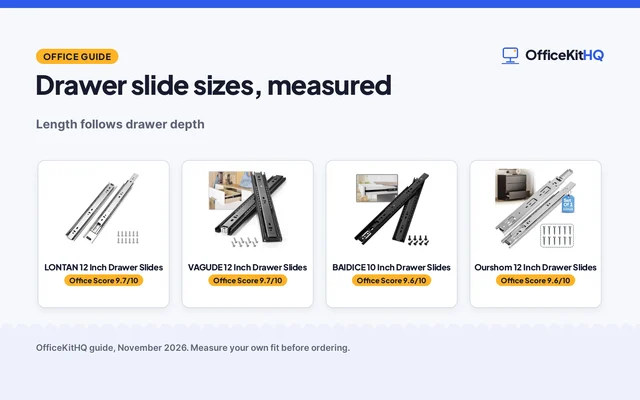
| VAGUDE 12-inch side mount | 12 in | 13 to 15 in |
| BAIDICE 10-inch side mount | 10 in | 10 to 12 in |
| PRIME-LINE 15-3/4-inch track | 15-3/4 in | 16 in deep cabinets |
Length is the closed slide, not the open reach: the VAGUDE 12-inch (on Amazon) slide extends to 24 in and the BAIDICE 10-inch (on Amazon) slide extends to 20 in when fully open. Measure the drawer box depth first, then pick a slide length from the listings that matches it.
Step 1: Find why the drawer sticks
Pull the drawer out as far as it goes and look at both slides before touching any screws. A drawer that sticks on one side often has a loose screw on that side, while a drawer that drops at the front may have a bent rail or a roller that has worn down. Push each slide in and out by hand and listen for grinding or a catch at the same spot on every pass. Check the drawer box too: a box that has gone out of square rubs one side of the opening even when the slides are sound. Note what is wrong before buying parts, since a loose screw needs a screwdriver and a bent rail needs a new slide.
Step 2: Measure the slide and the opening
Measure the closed slide from end to end, then measure the drawer box from front to back. The slide length should match the drawer depth: a 12-inch slide suits a drawer with an inner depth of 13 to 15 inches, and a 10-inch slide suits an inner depth of 10 to 12 inches. Next measure the gap between the drawer side and the cabinet wall on each side. Side mount slides need 0.5 inches of clearance on each side, which is 1 inch of total play across the opening, so a drawer that measures tight on one side and loose on the other is sitting off center. For a dresser or nightstand with a center guide, measure the guide length instead: replacement runners such as the lamxxyoo beech set are 16 inches long and cut to 15.75 inches. Write down the mount type, the length and the clearance before shopping. For cabinet depths, see the size of file cabinet guide.
Step 3: Fix the slide you have
Start with the simple repairs before replacing hardware. Tighten every screw on both slides and on the drawer box, then push the drawer in and out to see if it runs straight. Clean dust and grit out of the track with a dry cloth, since grit in the race stops the bearings from rolling. If the drawer still catches, loosen the screws on one slide, shift the slide until the drawer sits square in the opening and tighten the screws again. A roller or wheel that has worn flat cannot be tightened back into shape, and a slide with a bent rail or a cracked bracket needs a new pair. For bottom mount guides, the plastic track guide is often the worn part: Chenyu lists 168 track guides in sets of 5 and 10 for Rite-Trak II dresser drawers, with a pop-and-screw design that needs no tools.
Step 4: Replace the slide when repair is not enough
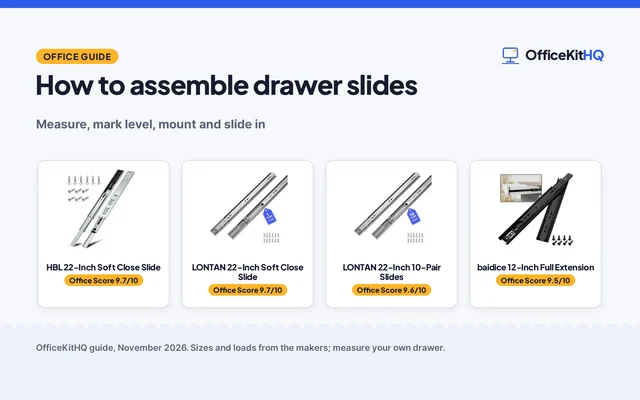
When the old slide is bent, cracked or missing parts, fit a new pair of the same length and mount type. Side mount ball bearing slides come in lengths from 8 to 24 inches, so match the new slide to the length you measured in Step 2. VAGUDE lists its slides at a 100 lbs load capacity with a 100,000-cycle life under full load, and BAIDICE lists the same 100 lbs capacity with 8 screws in the box and a maker-stated sound level of 35 decibels. Check the load capacity against what the drawer holds: a file drawer full of paper needs the full capacity, while a shallow desk drawer with pens and cables does not. Fit the cabinet side first, then the drawer side, and push the inner ball bearing to the top of the slide before fixing it in place, as the BAIDICE listing directs.
Drawer slide repair for dressers and old drawers
Dressers and nightstands often use center guides rather than side mount slides, and the repair is a part swap rather than a slide swap. Chenyu makes Rite-Trak II replacement guides in sets of 5 and 10, with a 5-year support term stated in the listing, and Moestoont lists a 10-pack of the same 168 track guides with a metal back. The guides fit dresser and nightstand drawers from makers such as Vaughan Bassett, Legacy and Ashley, according to the listings. For wooden center runners, the lamxxyoo set is solid beech wood in 16-inch lengths that cut to 15.75 inches, so measure the old runner and trim the new one to match. Old drawers also benefit from a check of the drawer box itself: a loose joint or a swollen side makes even a new slide bind, so fix the box before blaming the hardware.
FAQ
What size drawer slide do I need?
Match the slide length to the drawer depth and leave 0.5 inches of clearance on each side. A 12-inch slide suits a drawer with an inner depth of 13 to 15 inches, a 10-inch slide suits 10 to 12 inches, and PRIME-LINE lists 15-3/4-inch tracks for cabinets 16 inches deep. Measure the drawer box and the opening before ordering.
How much weight can a drawer slide hold?
It depends on the slide: VAGUDE and BAIDICE both list a 100 lbs load capacity for their full extension ball bearing slides. Lighter center guides and wooden runners suit small drawers, so check the capacity in the listing against what the drawer holds before fitting it.
Can I replace only the worn part of a drawer slide?
Often yes. On bottom mount dresser systems the plastic track guide is the part that wears, and Chenyu lists 168 track guides in sets of 5 and 10 for Rite-Trak II drawers. On ball bearing side mount slides, a bent rail means replacing the pair, since the rail and bearings are built into the slide.
Why does my drawer stick on one side?
One side usually means one slide: a loose screw, a bent rail or a worn roller on that side, or a drawer box that has gone out of square. Loosen the screws on the catching side, shift the slide until the drawer sits square and tighten the screws again. If the slide is bent or the roller is worn flat, replace that pair.
More for your workspace
See the office storage guides, the best filing cabinets with shelves, the best drawer liners for desks and the size of file cabinet guide.