A video call starts in a spare room, the laptop fan hums, and the voice on the other end sounds far away. The types of wireless microphones on the market solve that problem in different ways: a lavalier clips to a shirt, a handheld rests in the palm, a headset sits over the ears, and a shotgun points at the speaker from a mount. Each type trades reach, freedom of movement, and ease of setup against the others, and the right one depends on where the speaker stands and what the mic must pick up. This guide walks through each type, with stated figures where they help.
OfficeKitHQ earns a commission when you buy through links on this page, at no extra cost to you. As an Amazon Associate I earn from qualifying purchases. Affiliate disclosure.
Types of wireless microphones at a glance
| Type | How it sits | Good for |
|---|---|---|
| Lavalier | Clips to a shirt or collar | Interviews, vlogs, calls |
| Handheld | Held in the hand | Singing, speaking, events |
| Headset | Worn over the ears, boom near the mouth | Calls, streaming, long sessions |
| Shotgun | Mounted on a camera or a boom arm | Video, streaming, a set desk |
Lavalier microphones
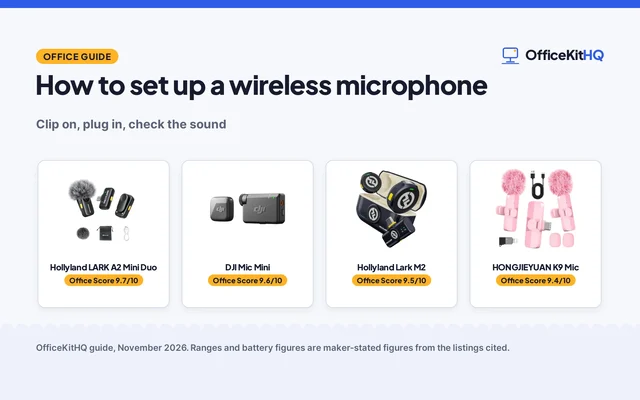
A lavalier microphone clips to a shirt or a collar and leaves the hands free, which makes it the quiet workhorse of interviews, vlogs, and video calls. The transmitter is small enough to hide under a jacket, and the receiver plugs into the camera or the computer. The DJI Mic Mini (on Amazon) shows how small this type can run: the maker lists the transmitter at 10 g, a 400m max transmission range, 48kHz sampling, and 120 dB SPL, with 2 noise cancellation levels and automatic limiting that lowers the volume when the input runs too loud. The set carries 2 transmitters and 1 receiver with a charging case, and the maker lists 48 hours of battery life with the case. That shape suits a speaker who moves around a room, since the mic travels with the shirt and stays the same distance from the mouth.
Handheld microphones
A handheld microphone is the classic shape: a handle with a mic at the top, held in the hand and passed from speaker to speaker. It suits singing, speaking, and events where the mic moves around the room. The MRSDY set shows the wireless version of the shape: 2 handheld microphones with cardioid pickup, a 2.4GHz link to the receiver, and a stated 30m/100ft range. The maker lists over 10 hours of use from a charge, with a charging time of 2-3 hours, and the receiver connects through 6.35mm (1/4 inch) or 3.5mm (1/8 inch) connectors to speakers, karaoke machines, amplifiers, and PA systems. A 1 Year warranty is stated. Volume control and a one-touch mute sit on the mic itself, so the speaker can adjust without walking back to the receiver.
Headset microphones
A headset microphone sits over the ears like headphones, with a small boom that ends near the mouth. The mic stays at the same distance from the mouth no matter where the head turns, which keeps the volume steady through a long call or a stream. The hands stay free, and the earpieces shut out some of the room sound. That shape suits calls, streaming, and any session where the speaker talks for a long stretch without holding a mic. The trade is comfort over a long session and a look that feels less formal on camera than a lavalier.
Shotgun microphones
A shotgun microphone is a long tube that mounts on a camera, a boom arm, or a desk stand and points at the speaker. It picks up sound from the direction it points and lets the room sound fall away, which suits video and streaming from a set spot. The speaker never wears it and never holds it, so it stays out of the frame and out of the hands. The trade is aim: the speaker must stay in front of the mic, and a speaker who turns away or walks off will sound thin. For a desk that never moves and a speaker who stays in the chair, a shotgun is the tidy choice.
How to choose among the types of wireless microphones
Start with where the speaker sits and how much the speaker moves. A speaker who walks around a room wants a lavalier or a handheld, since the mic travels with the speaker. A speaker who sits at a desk through calls wants a headset or a shotgun, since the mic stays put and the hands stay free. Then check the stated range: the DJI listing states a 400m max transmission range, while the MRSDY listing states 30m/100ft, so a large room or an outdoor event calls for the longer stated range. Battery life matters for long sessions: the DJI set lists 48 hours of battery life with the charging case, while the MRSDY set lists over 10 hours of use. Connectors matter too: the MRSDY receiver uses 6.35mm (1/4 inch) or 3.5mm (1/8 inch) connectors, so check that the speaker system or the audio interface takes one of those. Weight matters when the mic clips to a shirt: the DJI transmitter weighs 10 g. For setup steps once the type is chosen, see the wireless microphone setup guide and the USB microphone setup guide.
FAQ
What is the best type of wireless microphone for video calls?
A lavalier or a headset, since both leave the hands free and keep the mic near the mouth through a long call. A lavalier hides under a jacket and suits a speaker on camera, while a headset keeps the mic at a steady distance and suits a speaker who talks for hours. A handheld works too, but holding it through a long call takes a hand.
Do wireless microphones need WiFi?
No. The MRSDY set runs on a 2.4GHz link between the mics and the receiver, with no WiFi network involved, and most wireless microphones use a radio link of their own or a Bluetooth link instead of WiFi. WiFi is one way to carry audio, not the way these mics work.
How far can a wireless microphone reach?
It depends on the model and the stated range. The DJI listing states a 400m max transmission range, while the MRSDY listing states 30m/100ft. Walls, crowds, and other radio signals can shorten the working range, so read the stated range as a ceiling, not a promise for every room.
How long does a wireless microphone battery last?
It depends on the model and the charging case. The DJI set lists 48 hours of battery life with the charging case, while the MRSDY set lists over 10 hours of use from a charge, with a charging time of 2-3 hours. A charging case stretches the working time by topping up the transmitters between uses.
Can a wireless microphone connect to a phone?
Yes, when the set offers a receiver or a direct link that the phone accepts. The DJI Mic Mini is made for cameras and phones, and the receiver or the direct link carries the audio into the phone. Check the maker listing for the phone connection before buying, since not every set offers one.
More for your workspace
See the wireless microphone setup guide, the best wireless microphone for interviews guide, the best wireless lavalier mic guide and the headset types guide.