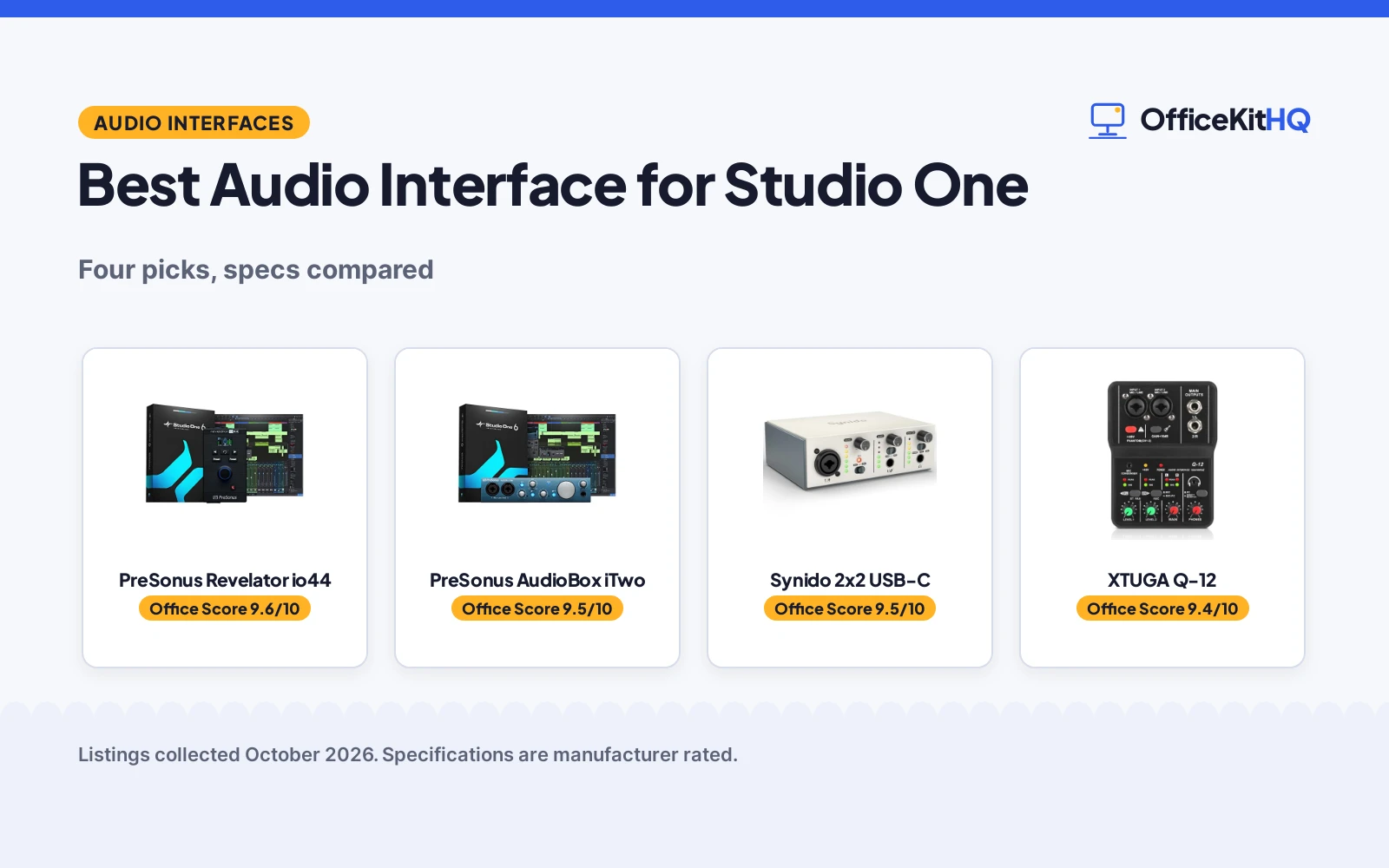
A spare room desk with a microphone, guitar and headphones within reach is where the best audio interface for studio one earns its place, turning separate gear into a recording path that stays ready at the desk. We compared four audio interfaces on inputs, USB connection, stated resolution, included Studio One software and warranty terms. The two PreSonus picks include Studio One Artist, while the Synido and XTUGA picks state USB-C or USB connections with 48V phantom power in their model names.
OfficeKitHQ earns a commission when you buy through links on this page, at no extra cost to you. As an Amazon Associate I earn from qualifying purchases. Affiliate disclosure.
Quick picks
 Best Overall PreSonus Revelator io44: Four inputs with built-in mixer, effects presets and Studio One Artist Check price on Amazon
 Best for MIDI PreSonus AudioBox iTwo: 2 combo inputs at 24-bit/96 kHz with MIDI In and Out stated Check price on Amazon
 USB-C Option Synido 2×2 USB-C: 2×2 USB-C design with XLR, 48V phantom power and 3 monitoring modes Check price on Amazon
 USB Option XTUGA Q-12: USB interface rated at 16-Bit/48kHz with 48V phantom power Check price on Amazon
Our desk picks
| # | Product | Office Score | Buy |
|---|---|---|---|
| 1 | PreSonus Revelator io44 | 9.6/10 | Buy on Amazon |
| 2 | PreSonus AudioBox iTwo | 9.5/10 | Buy on Amazon |
| 3 | Synido Live 005 | 9.5/10 | Buy on Amazon |
| 4 | XTUGA Q-12 | 9.4/10 | Buy on Amazon |

PreSonus Revelator io44
A USB-C audio interface with four flexible inputs, a built-in mixer and effects, and Studio One Artist recording software included.
Pros
- Four flexible inputs for mics, guitars, headsets and stereo sources
- Integrated mixer blends audio from up to three applications
- Onboard effects include reverb, compression, EQ and Voice FX
- Studio One Artist and Studio Magic bundle included
Cons
- Bus-powered by the connected USB-C device, so USB-C power is part of the desk setup
- Size at 3.03 x 5.35 x 2.3 inches takes desk depth for mixer controls
- Built-in effects and presets suit streaming and production more than plain recording
- Weight is 0.78 pounds for a setup that stays on the desk
Detailed Review
The maker lists a USB-C interface with four flexible inputs for mics, guitars, headsets and stereo sources, an XMAX-L preamp with 50 dB of adjustable gain and switchable +48V phantom power, and an integrated mixer for up to three applications. Onboard processing covers reverb, compression, EQ and Voice FX, and Studio One Artist with a Studio Magic bundle is included. Size is given as 3.03 x 5.35 x 2.3 inches at 0.78 pounds, with bus power from the connected USB-C device and a 1 year manufacturer warranty.
Who it's for: Studio One users at a home desk who record and stream with mics and instruments kept plugged in. Who should skip it: buyers who want a plain interface without onboard effects and mixer controls.
Its Office Score of 9.6/10 comes from performance 32/35, build 21/25, value 21/25, safety 0/10 and warranty 2/5: 76 of 100 points, placed on our 9.2 to 9.8 scale.
Key Specifications
| Inputs | Four flexible inputs |
|---|---|
| Connection | USB-C |
| Preamp gain | 50 dB |
| Size | 3.03 x 5.35 x 2.3 inches |
These specs mirror the retailer listing as of 20 November 2026; performance figures are stated by the brand.
Safety and Warranty
What this listing states. No volume limit or safety listing is stated, so safety scores zero. 1 year manufacturer warranty stated. It does not say everything a buyer needs, such as who pays return shipping, so warranty scores 2 of 5. See How We Pick.
Protect your hearing. Keep volume moderate during long calls, take breaks, and treat noise cancelling and battery figures as the maker's claims.
This is general buying information, not professional advice. Follow each product manual and local rules, and see our Safety Disclaimer.

PreSonus AudioBox iTwo
A 2x2 USB/iPad audio interface with 2 combo inputs, up to 24-bit/96 kHz conversion and Studio One Artist included.
Pros
- 2 combo inputs with Class A preamplifiers and +48V phantom power
- Up to 24-bit/96 kHz recording and playback stated
- Studio One Artist and Ableton Live Lite included
- 1x1 MIDI In/Out with a metal chassis
Cons
- Weight is 1.04 pounds, heavier to carry than the Revelator io44 at 0.78 pounds
- 2 inputs suit solo recording more than sessions with stereo sources kept plugged in
- Blue finish is the color given for this model
- Capture Duo wireless transfer is for iPad, so computer users use the USB path
Detailed Review
The maker lists a bus-powered USB 2.0 and iPad interface with 2 combo microphone, instrument and line inputs, Class A preamplifiers, +48V phantom power and up to 24-bit/96 kHz recording and playback. Studio One Artist, Ableton Live Lite and a Studio Magic plug-in suite are included, with Capture Duo for iPad and wireless transfer to Studio One. Outputs cover 2 balanced TRS main outputs and a stereo headphone output, with zero-latency monitoring, a metal chassis and 1x1 MIDI In/Out.
Who it's for: Studio One users who record with a microphone and instrument and use MIDI gear at the desk. Who should skip it: buyers who need four inputs kept plugged in or a USB-C connection.
Its Office Score of 9.5/10 comes from performance 29/35, build 22/25, value 21/25, safety 0/10 and warranty 0/5: 72 of 100 points, placed on our 9.2 to 9.8 scale.
Key Specifications
| Inputs | 2 combo inputs |
|---|---|
| Resolution | Up to 24-bit/96 kHz |
| MIDI | 1x1 In/Out |
| Size | 17.88 x 8.38 x 8.88 inches |
These specs mirror the retailer listing as of 20 November 2026; performance figures are stated by the brand.
Safety and Warranty
What this listing states. No volume limit or safety listing is stated, so safety scores zero. No warranty term, so warranty scores zero. See How We Pick.
Protect your hearing. Keep volume moderate during long calls, take breaks, and treat noise cancelling and battery figures as the maker's claims.
This is general buying information, not professional advice. Follow each product manual and local rules, and see our Safety Disclaimer.

Synido Live 005
A 2-channel USB-C interface with XLR and 6.35mm inputs, 24-bit/48kHz sound, 48V phantom power and 3 monitoring modes.
Pros
- 48V phantom power switch is stated for microphones
- 3 monitoring modes cover recording, live broadcast and post-editing
- 24-bit depth and 48kHz sampling rate are stated
- Line In and Hi-Z switching adapts to different devices
Cons
- 30 days warranty is the smallest term here
- Third-party ASIO driver is recommended for a DAW
- No software bundle is stated in the listing
Detailed Review
Synido lists a 2-channel USB-C interface with XLR and 6.35mm inputs, 24-bit depth and 48kHz sampling rate, 48V phantom power and 3 monitoring modes for stereo, mix and USB monitoring. The listing states green, orange and red gain lights, Line In and Hi-Z switching, and a USB-C to USB-A cable with a 3.5mm to 6.35mm adapter. The bullets state a weight of 300g and dimensions of 14 by 11.5 by 4.5 cm, while the spec table states 4.53 in by 5.51 in by 1.77 in and an item weight of 0.91 lb, so trust the bullets over the spec table for the weight and check the size before ordering.
Who it's for: someone who records with a mic or an instrument and wants 3 monitoring modes with 48V phantom power. Who should skip it: anyone who wants a longer warranty, a pocket-size interface, or no extra driver download.
Its Office Score of 9.5/10 comes from performance 32/35, build 21/25, value 21/25, safety 0/10 and warranty 1/5: 75 of 100 points, placed on our 9.2 to 9.8 scale.
Key Specifications
| Sample rate | 24-bit/48kHz |
|---|---|
| Inputs | XLR, 6.35mm |
| Phantom power | 48V |
| Monitoring | 3 modes |
Figures as published on the retailer listing, collected 10 November 2026. Performance figures are manufacturer rated.
Safety and Warranty
What this listing states. No volume limit or safety listing is stated, so safety scores zero. 30 days warranty. It does not say everything a buyer needs, such as who pays return shipping, so warranty scores 1 of 5. See How We Pick.
Protect your hearing. Keep volume moderate during long calls, take breaks, and treat noise cancelling and battery figures as the maker's claims.
This is general buying information, not professional advice. Follow each product manual and local rules, and see our Safety Disclaimer.

XTUGA Q-12
A compact USB interface with 16-bit/48kHz resolution, XLR and 3.5mm inputs, 48V phantom power and plug-and-play setup for students and beginners.
Pros
- 48V phantom power drives condenser microphones
- XLR and 3.5mm inputs for microphones and daily recording
- Plug-and-play USB power with no external adapter needed
- Lightest interface here at 0.68 lb
Cons
- 16-bit/48kHz is the lowest resolution in this group
- Only one XLR input, so two condenser microphones at once need a bigger interface
- No direct monitor switch is named, unlike the JOLGOO
- No MIDI I/O stated, unlike the Behringer UMC404HD
Detailed Review
XTUGA lists the Q-12 as a USB audio interface with 16-bit/48kHz resolution, XLR and 3.5mm inputs and switchable 48V phantom power for condenser microphones. It is USB-powered from the computer with no external adapter, and it is described as an interface for students and beginners building a 2-channel home studio. The unit weighs 0.68 lb.
Who it's for: a student or beginner building a first 2-channel home studio for vocals or karaoke who wants plug-and-play setup. Who should skip it: anyone who needs 24-bit recording or two XLR inputs at once.
Its Office Score of 9.4/10 comes from performance 26/35, build 19/25, value 20/25, safety 0/10 and warranty 0/5: 65 of 100 points, placed on our 9.2 to 9.8 scale.
Key Specifications
| Resolution | 16-bit/48kHz |
|---|---|
| Inputs | XLR and 3.5mm |
| Phantom power | 48V |
| Item weight | 0.68 lb |
These specs mirror the retailer listing as of 18 November 2026; performance figures are stated by the brand.
Safety and Warranty
What this listing states. No volume limit or safety listing is stated, so safety scores zero. No warranty term, so warranty scores zero. See How We Pick.
Protect your hearing. Keep volume moderate during long calls, take breaks, and treat noise cancelling and battery figures as the maker's claims.
This is general buying information, not professional advice. Follow each product manual and local rules, and see our Safety Disclaimer.
As an Amazon Associate I earn from qualifying purchases.
More picks to compare
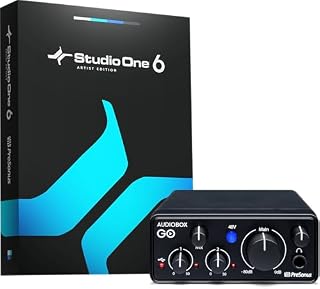 PreSonus AudioBox GOUSB-C interface with Studio One Prime for mic and instrument recording.Check on Amazon
 Mackie Onyx ArtistUSB interface at 24-Bit/192kHz with Onyx preamp and phantom power.Check on Amazon
Specs compared
| Interface | Office Score | Inputs | Connection | Resolution | Studio One software | Warranty | Amazon |
|---|---|---|---|---|---|---|---|
| PreSonus Revelator io44 | 9.6/10 | Four flexible inputs | USB-C | Not stated | Studio One Artist | 1 year manufacturer | View on Amazon |
| PreSonus AudioBox iTwo | 9.5/10 | 2 combo inputs | USB 2.0 | 24-bit/96 kHz | Studio One Artist | Not stated | View on Amazon |
| Synido 2×2 USB-C | 9.5/10 | 2×2 with XLR | USB-C | Not stated | Not stated | Not stated | |
| XTUGA Q-12 | 9.4/10 | Not stated | USB | 16-Bit/48kHz | Not stated | Not stated | View on Amazon |
We quote these figures from each listing as the brand rates them; captured 20 November 2026.
How to choose the best audio interface for studio one
Start with Studio One software in the box
For this search, included software separates the group. The PreSonus Revelator io44 includes Studio One Artist with a Studio Magic bundle of tutorials, samples and virtual instruments. The PreSonus AudioBox iTwo includes Studio One Artist and Ableton Live Lite with a Studio Magic plug-in suite, plus Capture Duo for iPad with wireless transfer to Studio One. If Studio One is your recording program, those two picks put the software in the box. For a wider view of interface types, see our best audio interface guide.
Inputs, preamps and phantom power
Input count decides what stays plugged in at the desk. The PreSonus Revelator io44 gives four flexible inputs for mics, guitars, headsets and stereo sources, with an XMAX-L preamp rated at 50 dB of gain and switchable +48V phantom power. The PreSonus AudioBox iTwo gives 2 combo microphone, instrument and line inputs with Class A preamplifiers and +48V phantom power. The Synido 2×2 USB-C gives a 2×2 format with XLR and 48V phantom power, and the XTUGA Q-12 gives 48V phantom power. Match the input count to the microphones and instruments you keep on the desk.
Connection and resolution
Connection type must match the computer port at the desk. The PreSonus Revelator io44 and Synido 2×2 USB-C use USB-C, the PreSonus AudioBox iTwo uses USB 2.0 and iPad connections, and the XTUGA Q-12 uses USB. Resolution figures differ: the PreSonus AudioBox iTwo allows up to 24-bit/96 kHz recording and playback, and the XTUGA Q-12 is rated at 16-Bit/48kHz. The PreSonus Revelator io44 and Synido 2×2 USB-C state no bit depth figure in the facts compared here. See our best audio interface for home recording guide for more desk setups.
| Interface | Connection | Resolution |
|---|---|---|
| PreSonus Revelator io44 | USB-C | Not stated |
| PreSonus AudioBox iTwo | USB 2.0 | 24-bit/96 kHz |
| Synido 2×2 USB-C | USB-C | Not stated |
| XTUGA Q-12 | USB | 16-Bit/48kHz |
Monitoring, outputs and desk fit
Monitoring controls shape daily use at a small desk. The PreSonus Revelator io44 has an integrated mixer that blends audio from up to three applications, with onboard reverb, compression, EQ and Voice FX. The PreSonus AudioBox iTwo has 2 balanced TRS main outputs, a stereo headphone output with independent level control, zero-latency monitoring and 1×1 MIDI In/Out. The Synido 2×2 USB-C gives 3 monitoring modes. Sizes also differ: the PreSonus Revelator io44 is given as 3.03 x 5.35 x 2.3 inches at 0.78 pounds, and the PreSonus AudioBox iTwo is given as 17.88 x 8.38 x 8.88 inches at 1.04 pounds.
Setup Notes
- Count desk inputs before ordering: four flexible inputs on the PreSonus Revelator io44, 2 combo inputs on the PreSonus AudioBox iTwo, and a 2×2 format on the Synido 2×2 USB-C.
- Match the stated connection to the computer port: USB-C, USB 2.0 or USB across these four picks.
- Check phantom power figures for condenser microphones: +48V on both PreSonus picks and 48V on the Synido and XTUGA picks.
- Plan desk space from stated sizes: 3.03 x 5.35 x 2.3 inches for the PreSonus Revelator io44 and 17.88 x 8.38 x 8.88 inches for the PreSonus AudioBox iTwo.
FAQ
Which picks include Studio One software?
The PreSonus Revelator io44 includes Studio One Artist, and the PreSonus AudioBox iTwo includes Studio One Artist with Ableton Live Lite. Both also include Studio Magic software as listed for each pick.
How many inputs do these interfaces give?
The PreSonus Revelator io44 gives four flexible inputs, the PreSonus AudioBox iTwo gives 2 combo inputs, and the Synido 2×2 USB-C gives a 2×2 format. The XTUGA Q-12 input count is Not stated in the facts compared here.
Which connection does each pick use?
The PreSonus Revelator io44 and Synido 2×2 USB-C use USB-C, the PreSonus AudioBox iTwo uses USB 2.0 and iPad connections, and the XTUGA Q-12 uses USB. Match the stated connection to the port on your computer.
What resolution figures are stated?
The PreSonus AudioBox iTwo allows up to 24-bit/96 kHz recording and playback, and the XTUGA Q-12 is rated at 16-Bit/48kHz. The PreSonus Revelator io44 and Synido 2×2 USB-C state no bit depth figure in the facts compared here.
Which picks state a warranty term?
One of the four picks states a term: the PreSonus Revelator io44 states 1 year manufacturer coverage. The PreSonus AudioBox iTwo, Synido 2×2 USB-C and XTUGA Q-12 state no warranty term in the facts compared here.
Score breakdown
The Office Score weighs performance, build, value, safety and warranty. For audio interfaces, safety means certifications the maker actually states; none of the four picks states one, so each scores zero on that line, whatever its inputs. One of the four picks states a warranty term. How we pick explains the weights.
| Product | Office Score | Perf. /35 | Build /25 | Value /25 | Safety /10 | Warranty /5 |
|---|---|---|---|---|---|---|
| PreSonus Revelator io44 | 9.6 | 32 | 21 | 21 | 0 | 2 |
| PreSonus AudioBox iTwo | 9.5 | 29 | 22 | 21 | 0 | 0 |
Score placement follows the weighted total: the lowest totals read 9.2, the highest 9.8, and everything between keeps its order.
More for your workspace
See every Audio, Power and Connectivity guide for desk audio and connection gear.
More picks: best audio interface, best audio interface for home recording, best audio interface for beginners.