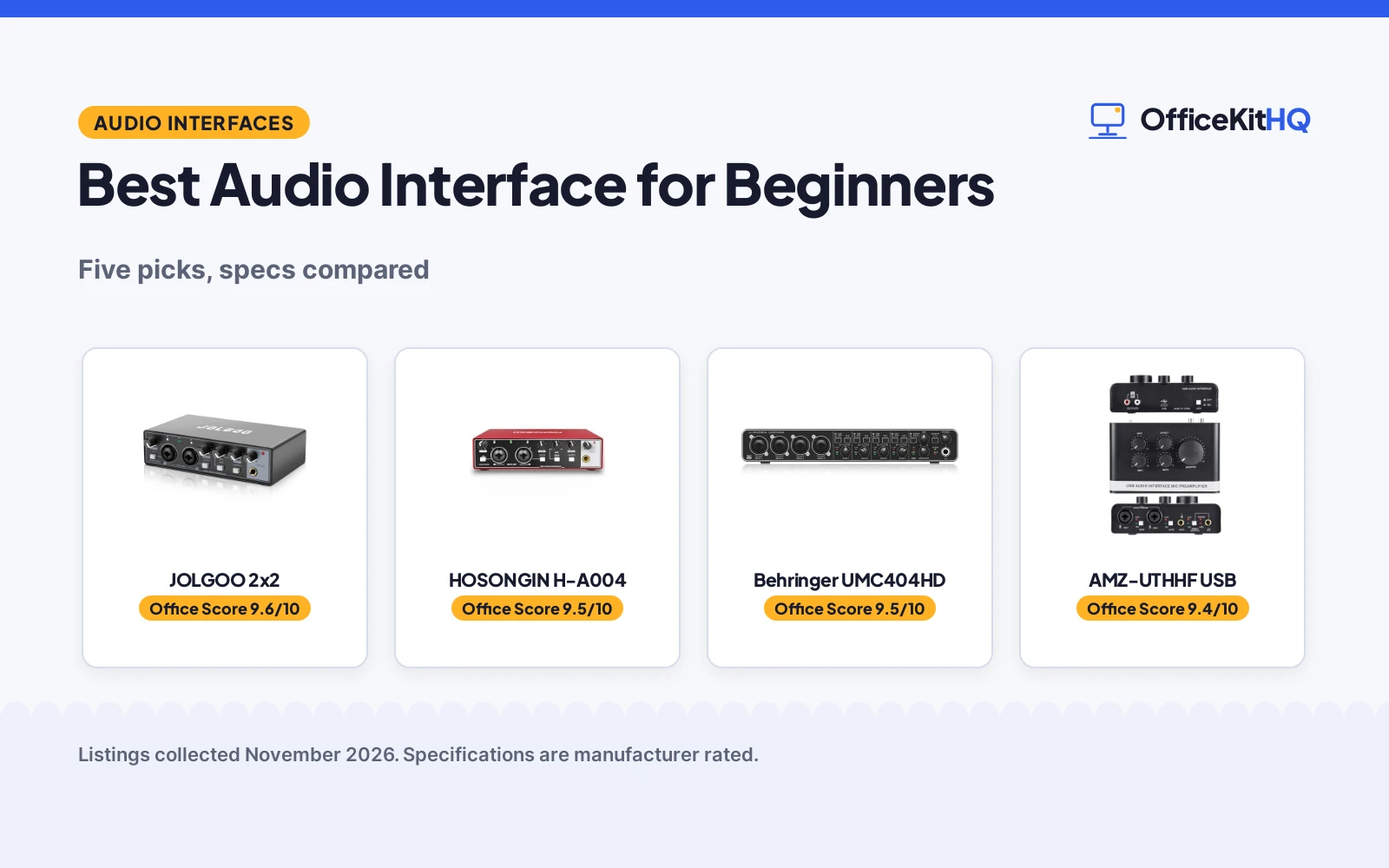
The best audio interface for beginners is the one that turns a microphone and a guitar into a clean recording on a laptop without a setup process that eats the whole evening. A first podcast episode recorded at a home desk on a laptop microphone sounds thin next to a guest on a proper mic, and a first song idea fades when the interface needs drivers, adapters and a manual before it makes a sound. We compared USB audio interfaces by resolution, inputs, phantom power, direct monitoring, build and warranty term, using only what each maker publishes.
OfficeKitHQ earns a commission when you buy through links on this page, at no extra cost to you. As an Amazon Associate I earn from qualifying purchases. Affiliate disclosure.
Quick picks
 Best Overall JOLGOO 2×2: 24-bit/192kHz, dual combo inputs, direct monitor, 1-year warranty Check price on Amazon
 Best USB-C Pick HOSONGIN H-A004: 24-bit/192kHz, 48V phantom, USB-C, metal build, 1-year warranty Check price on Amazon
 Best Four-Input Behringer UMC404HD: 4 Midas preamps, 4-in/4-out, MIDI I/O, 24-bit/192kHz Check price on Amazon
 Best Echo Control AMZ-UTHHF USB: 48kHz, dual XLR/TRS plus instrument input, echo control Check price on Amazon
 Best for Students XTUGA Q-12: 16-bit/48kHz, 48V phantom, plug and play Check price on Amazon
Our desk picks
| # | Product | Office Score | Buy |
|---|---|---|---|
| 1 | JOLGOO 2x2 | 9.6/10 | Buy on Amazon |
| 2 | HOSONGIN H-A004 | 9.5/10 | Buy on Amazon |
| 3 | Behringer UMC404HD | 9.5/10 | Buy on Amazon |
| 4 | AMZ-UTHHF USB | 9.4/10 | Buy on Amazon |
| 5 | XTUGA Q-12 | 9.4/10 | Buy on Amazon |
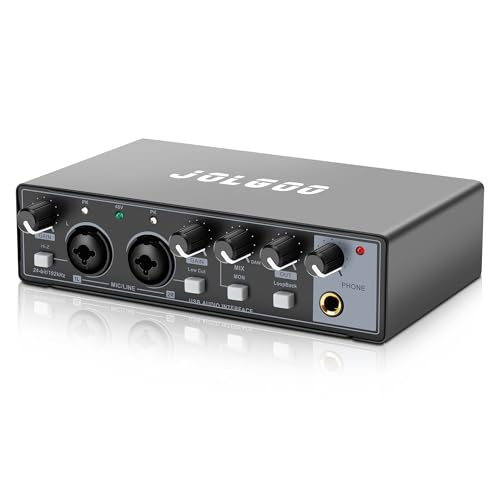
JOLGOO 2x2
A 2x2 USB interface with 24-bit/192kHz conversion, dual XLR/line combo inputs, 48V phantom power and direct monitoring in a metal housing.
Pros
- 24-bit/192kHz conversion with dual XLR/line combo inputs
- 48V phantom power with independent gain control and LED peak indicators
- Direct Monitor switch for zero-latency monitoring while recording
- Metal housing with headphone monitoring, stereo line-outs and USB-C and USB-A cables
Cons
- Two inputs only, so a four-microphone setup needs a bigger interface
- No MIDI I/O stated, unlike the Behringer UMC404HD
- Heavier than the HOSONGIN, AMZ-UTHHF and XTUGA
- No echo effect control is stated, unlike the AMZ-UTHHF
Detailed Review
JOLGOO lists the 2x2 as a 24-bit/192kHz USB interface with dual XLR/line combo inputs, independent gain control, LED peak indicators and 48V phantom power. The Direct Monitor switch gives zero-latency monitoring, and it works with Windows, macOS and iOS/Android devices and with Audacity, Ableton and Pro Tools. The metal housing includes headphone monitoring and stereo line-outs, and both USB-C and USB-A cables are included. The maker states a 1-year manufacturer warranty.
Who it's for: someone starting a home studio for vocals, guitar or podcasting who wants 24-bit/192kHz sound, direct monitoring and cables in the box. Who should skip it: anyone who needs four inputs at once or MIDI I/O.
Its Office Score of 9.6/10 comes from performance 30/35, build 21/25, value 21/25, safety 0/10 and warranty 3/5: 75 of 100 points, placed on our 9.2 to 9.8 scale.
Key Specifications
| Resolution | 24-bit/192kHz |
|---|---|
| Inputs | Dual XLR/line combo |
| Phantom power | 48V |
These specs mirror the retailer listing as of 18 November 2026; performance figures are stated by the brand.
Safety and Warranty
What this listing states. No volume limit or safety listing is stated, so safety scores zero. 1-year manufacturer warranty. It does not say everything a buyer needs, such as who pays return shipping, so warranty scores 3 of 5. See How We Pick.
Protect your hearing. Keep volume moderate during long calls, take breaks, and treat noise cancelling and battery figures as the maker's claims.
This is general buying information, not professional advice. Follow each product manual and local rules, and see our Safety Disclaimer.

HOSONGIN H-A004
A compact metal USB-C interface with 24-bit/192kHz audio, 48V phantom power and plug-and-play setup for podcast, vocal and guitar recording.
Pros
- 24-bit/192kHz audio with 48V phantom power for condenser microphones
- XLR/TRS combo input takes studio mics, guitars and basses
- Zero-latency monitoring through headphones
- Plug-and-play setup with no drivers required
Cons
- One combo input only, so two microphones at once need a bigger interface
- No direct monitor switch is named, unlike the JOLGOO
- Heavier than the XTUGA and AMZ-UTHHF
- No MIDI I/O stated, unlike the Behringer UMC404HD
Detailed Review
HOSONGIN lists this interface as a 24-bit/192kHz USB audio interface with 48V phantom power and an XLR/TRS combo input for studio mics, guitars and basses. Monitoring runs with zero latency through headphones, and the compact metal build fits a small desk. It works with PC, Mac and iOS and with GarageBand, OBS, Twitch, Zoom, Spotify and Apple Music, over a USB-C connection. The maker states a 1-year warranty.
Who it's for: a beginner recording podcasts, vocals or guitar who wants 24-bit/192kHz sound in a compact metal USB-C interface. Who should skip it: anyone who needs two microphone inputs at once or MIDI I/O.
Its Office Score of 9.5/10 comes from performance 29/35, build 21/25, value 21/25, safety 0/10 and warranty 3/5: 74 of 100 points, placed on our 9.2 to 9.8 scale.
Key Specifications
| Resolution | 24-bit/192kHz |
|---|---|
| Inputs | 1 XLR/TRS combo |
| Phantom power | 48V |
These specs mirror the retailer listing as of 18 November 2026; performance figures are stated by the brand.
Safety and Warranty
What this listing states. No volume limit or safety listing is stated, so safety scores zero. 1-year warranty. It does not say everything a buyer needs, such as who pays return shipping, so warranty scores 3 of 5. See How We Pick.
Protect your hearing. Keep volume moderate during long calls, take breaks, and treat noise cancelling and battery figures as the maker's claims.
This is general buying information, not professional advice. Follow each product manual and local rules, and see our Safety Disclaimer.
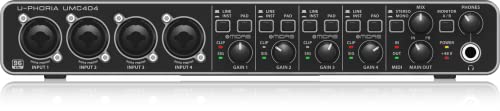
Behringer UMC404HD
A 4-in/4-out USB 2.0 interface with 24-bit/192kHz conversion, four Midas mic preamps and MIDI I/O for larger recording setups.
Pros
- Four Midas mic preamps with 4-in/4-out recording
- 24-bit/192kHz conversion
- MIDI I/O is included alongside the audio inputs
- Largest input count in this group, with four preamps
Cons
- No warranty term is stated
- Heaviest interface here
- Widest stated here at 9.7 in
- USB 2.0 connection rather than USB-C
Detailed Review
Behringer lists the UMC404HD as a 4x4 USB 2.0 audio interface with 24-bit/192kHz conversion, four Midas mic preamps and MIDI I/O, for macOS and Windows. It is the only interface here with four preamps and the only one with MIDI I/O. The unit measures 1.1 by 9.7 by 6.5 in. No warranty term is stated, so warranty scores zero.
Who it's for: someone recording several sources at once who wants four preamps, MIDI I/O and 24-bit/192kHz conversion. Who should skip it: anyone who wants a compact two-input interface or a warranty term in writing.
Its Office Score of 9.5/10 comes from performance 33/35, build 22/25, value 22/25, safety 0/10 and warranty 0/5: 77 of 100 points, placed on our 9.2 to 9.8 scale.
Key Specifications
| Resolution | 24-bit/192kHz |
|---|---|
| Inputs | 4-in/4-out |
| Preamps | 4 Midas |
These specs mirror the retailer listing as of 18 November 2026; performance figures are stated by the brand.
Safety and Warranty
What this listing states. No volume limit or safety listing is stated, so safety scores zero. No warranty term, so warranty scores zero. See How We Pick.
Protect your hearing. Keep volume moderate during long calls, take breaks, and treat noise cancelling and battery figures as the maker's claims.
This is general buying information, not professional advice. Follow each product manual and local rules, and see our Safety Disclaimer.

AMZ-UTHHF USB
A USB-C interface with 48V phantom power, dual XLR/TRS combo inputs plus an instrument input, direct monitoring and echo control for podcast and streaming.
Pros
- Dual XLR/TRS combo inputs plus a separate instrument input
- 48V phantom power for condenser microphones
- Direct Monitor with adjustable echo effect control
- USB-C connection compatible with PC, Mac, iOS and Windows 11
Cons
- 48kHz maximum sample rate, below the 192kHz interfaces here
- 3-month warranty is the shortest term in this group
- No MIDI I/O stated, unlike the Behringer UMC404HD
- No metal housing is stated, unlike the JOLGOO and HOSONGIN
Detailed Review
The maker lists 48V phantom power, dual XLR/TRS combo inputs, one instrument input and direct monitoring with an adjustable echo effect control. Independent controls cover MIC/LINE gain for both channels, instrument gain, echo effect and monitor volume. It connects over USB-C and supports 48kHz maximum sample rate with 2-channel audio, for PC, Mac, iOS and Windows 11. The item weighs 1.5 lb, and the maker states a 3-month warranty period.
Who it's for: someone recording vocals, guitar or karaoke who wants echo control and a separate instrument input in a USB-C interface. Who should skip it: anyone who needs 24-bit/192kHz recording or a longer warranty term.
Its Office Score of 9.4/10 comes from performance 27/35, build 19/25, value 20/25, safety 0/10 and warranty 2/5: 68 of 100 points, placed on our 9.2 to 9.8 scale.
Key Specifications
| Resolution | 48kHz |
|---|---|
| Inputs | 2 combo plus instrument |
| Phantom power | 48V |
| Item weight | 1.5 lb |
These specs mirror the retailer listing as of 18 November 2026; performance figures are stated by the brand.
Safety and Warranty
What this listing states. No volume limit or safety listing is stated, so safety scores zero. 3-month warranty. It does not say everything a buyer needs, such as who pays return shipping, so warranty scores 2 of 5. See How We Pick.
Protect your hearing. Keep volume moderate during long calls, take breaks, and treat noise cancelling and battery figures as the maker's claims.
This is general buying information, not professional advice. Follow each product manual and local rules, and see our Safety Disclaimer.

XTUGA Q-12
A compact USB interface with 16-bit/48kHz resolution, XLR and 3.5mm inputs, 48V phantom power and plug-and-play setup for students and beginners.
Pros
- 48V phantom power drives condenser microphones
- XLR and 3.5mm inputs for microphones and daily recording
- Plug-and-play USB power with no external adapter needed
- Lightest interface here at 0.68 lb
Cons
- 16-bit/48kHz is the lowest resolution in this group
- Only one XLR input, so two condenser microphones at once need a bigger interface
- No direct monitor switch is named, unlike the JOLGOO
- No MIDI I/O stated, unlike the Behringer UMC404HD
Detailed Review
XTUGA lists the Q-12 as a USB audio interface with 16-bit/48kHz resolution, XLR and 3.5mm inputs and switchable 48V phantom power for condenser microphones. It is USB-powered from the computer with no external adapter, and it is described as an interface for students and beginners building a 2-channel home studio. The unit weighs 0.68 lb.
Who it's for: a student or beginner building a first 2-channel home studio for vocals or karaoke who wants plug-and-play setup. Who should skip it: anyone who needs 24-bit recording or two XLR inputs at once.
Its Office Score of 9.4/10 comes from performance 26/35, build 19/25, value 20/25, safety 0/10 and warranty 0/5: 65 of 100 points, placed on our 9.2 to 9.8 scale.
Key Specifications
| Resolution | 16-bit/48kHz |
|---|---|
| Inputs | XLR and 3.5mm |
| Phantom power | 48V |
| Item weight | 0.68 lb |
These specs mirror the retailer listing as of 18 November 2026; performance figures are stated by the brand.
Safety and Warranty
What this listing states. No volume limit or safety listing is stated, so safety scores zero. No warranty term, so warranty scores zero. See How We Pick.
Protect your hearing. Keep volume moderate during long calls, take breaks, and treat noise cancelling and battery figures as the maker's claims.
This is general buying information, not professional advice. Follow each product manual and local rules, and see our Safety Disclaimer.
As an Amazon Associate I earn from qualifying purchases.
More picks to compare
 TAVOSOP Q-1216-bit/48kHz interface with 48V phantom power for beginnersCheck on Amazon
Specs compared
| Interface | Office Score | Resolution | Inputs | Phantom power | Warranty | Amazon |
|---|---|---|---|---|---|---|
| JOLGOO 2×2 | 9.6/10 | 24-bit/192kHz | 2 combo inputs | 48V | 1 year | |
| HOSONGIN H-A004 | 9.5/10 | 24-bit/192kHz | 1 combo input | 48V | 1 year | View on Amazon |
| Behringer UMC404HD | 9.5/10 | 24-bit/192kHz | 4 preamps | Not stated | Not stated | View on Amazon |
| AMZ-UTHHF USB | 9.4/10 | 48kHz | 2 combo plus instrument | 48V | 3 months | View on Amazon |
| XTUGA Q-12 | 9.4/10 | 16-bit/48kHz | XLR and 3.5mm | 48V | Not stated | View on Amazon |
Dimensions, weight limits and ranges are the maker’s ratings as each listing gives them, collected 18 November 2026. Three of the five state a warranty term; none states a safety certification.
How to choose the best audio interface for beginners
Start with resolution and inputs
Resolution is the first split in this group. The Behringer, JOLGOO and HOSONGIN record at 24-bit/192kHz, the AMZ-UTHHF supports a 48kHz maximum sample rate, and the XTUGA records at 16-bit/48kHz. Inputs split the group a second way: the Behringer gives four preamps with 4-in/4-out recording, the JOLGOO gives dual XLR/line combo inputs, the HOSONGIN gives one XLR/TRS combo input, the AMZ-UTHHF gives dual XLR/TRS combo inputs plus one instrument input, and the XTUGA gives XLR and 3.5mm inputs. Match the input count to the sources you record at once: one microphone and one guitar need two inputs, while four microphones need the Behringer.
| Interface | Resolution | Inputs | Phantom power |
|---|---|---|---|
| JOLGOO 2×2 | 24-bit/192kHz | 2 combo | 48V |
| HOSONGIN H-A004 | 24-bit/192kHz | 1 combo | 48V |
| Behringer UMC404HD | 24-bit/192kHz | 4 preamps | Not stated |
| AMZ-UTHHF USB | 48kHz | 2 combo plus instrument | 48V |
| XTUGA Q-12 | 16-bit/48kHz | XLR and 3.5mm | 48V |
Figures as stated by each maker. Phantom power is the 48V supply a condenser microphone needs, so check it before pairing an interface with a condenser mic. Our condenser microphone for streaming guide covers mics that use it.
Phantom power and monitoring
Four of the five interfaces state 48V phantom power: the XTUGA, JOLGOO, HOSONGIN and AMZ-UTHHF. The Behringer states four Midas preamps but no phantom power figure, so a condenser microphone buyer should confirm it before ordering. Monitoring matters as much as power: the JOLGOO has a Direct Monitor switch for zero-latency monitoring, the HOSONGIN monitors with zero latency through headphones, and the AMZ-UTHHF has direct monitoring with an adjustable echo effect control. For podcast recording, a boom arm for podcasting keeps the microphone in place while you monitor.
Size, weight and cables
The XTUGA weighs 0.68 lb and the AMZ-UTHHF weighs 1.5 lb. The Behringer measures 1.1 by 9.7 by 6.5 in; the other three state no dimensions. Only the JOLGOO states cables in the box, with both USB-C and USB-A cables included, while the HOSONGIN and AMZ-UTHHF state USB-C connections and the Behringer states USB 2.0. Our audio interface for home recording guide compares more interfaces for a dedicated room.
Read the warranty line
Three listings state a warranty term. The JOLGOO and HOSONGIN state one year, and the AMZ-UTHHF states a 3-month warranty period. The Behringer and XTUGA state no warranty term. A short term is still a term in writing, and it is worth more than a vague promise when a knob or a jack fails.
Setup Notes
- Measure the desk space first: the Behringer measures 1.1 by 9.7 by 6.5 in, so check the width against the space beside the keyboard.
- Plan the USB connection: the JOLGOO includes USB-C and USB-A cables, the HOSONGIN and AMZ-UTHHF state USB-C connections, the XTUGA runs on USB power from the computer with plug-and-play setup, and the Behringer states USB 2.0.
- Count inputs before ordering: one microphone and one guitar need two inputs, and four microphones need the four preamps on the Behringer.
- Check phantom power for a condenser microphone: four interfaces state 48V, while the Behringer states no phantom power figure.
- Keep the warranty term with the receipt: one year on the JOLGOO and HOSONGIN, three months on the AMZ-UTHHF, and no term stated on the Behringer and XTUGA.
FAQ
What resolution do I need for a first podcast?
The JOLGOO, HOSONGIN and Behringer record at 24-bit/192kHz, the XTUGA records at 16-bit/48kHz, and the AMZ-UTHHF supports a 48kHz maximum sample rate. The JOLGOO and HOSONGIN pair 24-bit/192kHz sound with direct monitoring, which suits a first podcast setup.
Which of these interfaces has the most inputs?
The Behringer UMC404HD, with four Midas preamps and 4-in/4-out recording. The JOLGOO has dual combo inputs, the AMZ-UTHHF has dual combo inputs plus one instrument input, the HOSONGIN has one combo input, and the XTUGA has XLR and 3.5mm inputs.
Do I need phantom power for a condenser microphone?
Yes, a condenser microphone needs phantom power, and four interfaces here state 48V: the XTUGA, JOLGOO, HOSONGIN and AMZ-UTHHF. The Behringer states no phantom power figure, so confirm it before pairing that interface with a condenser microphone.
Which interfaces work with a phone or tablet?
The JOLGOO states compatibility with Windows, macOS and iOS/Android devices, and the HOSONGIN and AMZ-UTHHF state iOS compatibility. The Behringer states macOS and Windows, and the XTUGA is described for PC recording.
Which interfaces include cables?
Only the JOLGOO states cables in the box: USB-C and USB-A cables. The other listings state no cables, so check what is included before ordering if cables matter to you.
What does direct monitoring do?
Direct monitoring lets you hear your performance in real time while recording, without delay. The JOLGOO has a Direct Monitor switch, the HOSONGIN monitors with zero latency through headphones, and the AMZ-UTHHF has direct monitoring with echo control.
Score breakdown
The Office Score weighs performance (resolution, inputs, phantom power and monitoring), build (housing, size and item weight), value for the stated specs, safety and warranty. For an audio interface, safety means a stated safety certification or protection on the listing; none of the five listings states one, so safety scores zero across the group. Three listings state a warranty term: the JOLGOO and HOSONGIN at one year and the AMZ-UTHHF at three months. How we pick explains the weights.
| Product | Office Score | Perf. /35 | Build /25 | Value /25 | Safety /10 | Warranty /5 |
|---|---|---|---|---|---|---|
| JOLGOO 2×2 | 9.6 | 30 | 21 | 21 | 0 | 3 |
| HOSONGIN H-A004 | 9.5 | 29 | 21 | 21 | 0 | 3 |
| Behringer UMC404HD | 9.5 | 33 | 22 | 22 | 0 | 0 |
| AMZ-UTHHF USB | 9.4 | 27 | 19 | 20 | 0 | 2 |
| XTUGA Q-12 | 9.4 | 26 | 19 | 20 | 0 | 0 |
Office Scores run on a short 9.2 to 9.8 scale. We place each item’s weighted point total on it in proportion, so a larger total is always shown as a larger score.
More for your workspace
See every audio, power and connectivity guide. Also see our best audio interface for home recording. Also see our best USB microphone for vocals. Also see our best condenser microphone for streaming. Also see our best boom arm for podcasting. Also see our best pop filter for microphone.
More related guides (4)
More picks: headsets, computer speakers, docking stations and USB hubs.