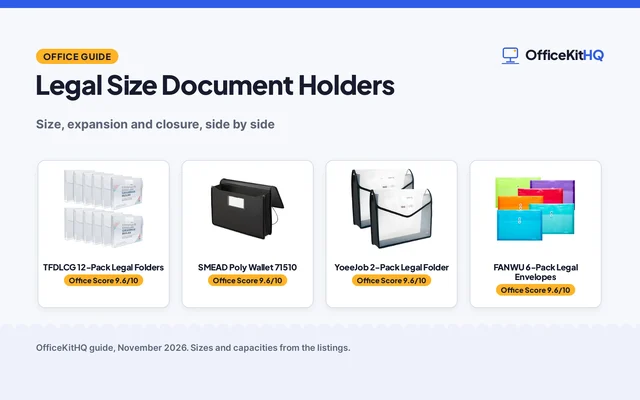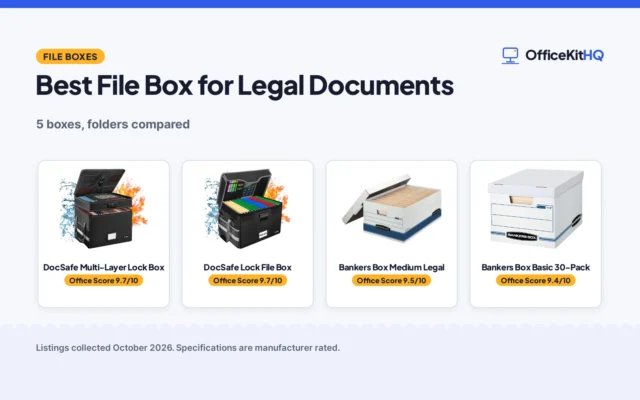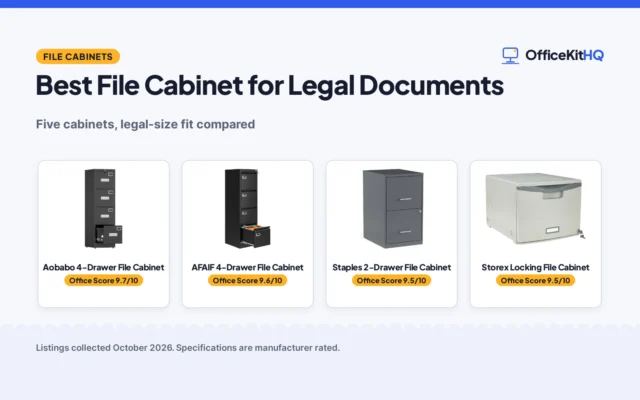
The stack on the corner of the desk gives the job away: long pages that stick out past the letter-size tray, a contract that needs a clean copy before lunch, and a filing box that will not close until every page is scanned. A document scanner legal size is a scanner that accepts those longer pages whole, so the full page reaches the file without folding, cropping or feeding the sheet in separate passes. The pages are longer than letter-size pages, which means the flatbed glass, the feeder path and the scan settings all need room for the extra length. This guide explains what to check in a listing before choosing one.
OfficeKitHQ earns a commission when you buy through links on this page, at no extra cost to you. As an Amazon Associate I earn from qualifying purchases. Affiliate disclosure.
The quick answer
Look for a listing that names legal-size support for both the flatbed and the automatic document feeder, since a scanner can accept a long page on the glass and still refuse it in the feeder. Duplex scanning matters too, because long double-sided pages need a pass for each side on a scanner that reads only a single side at a time. The Epson Workforce ES-590W (on Amazon) listing cited in this guide states double-sided scanning at up to 45 ppm and a 100-sheet auto document feeder, which shows the kind of figures to compare. Check the stated scan sizes first, then the feeder, then where the finished file goes.
Document scanner legal size: what the listing must state
Listings describe scanners with a mix of headline claims and a spec table, so read both and compare the figures with the work the scanner has to do. The table below gathers the concrete figures from the listing cited in this guide, and each row names the check it belongs to. A listing that states these figures clearly is easier to compare with the next listing, and a listing that leaves them out leaves the choice to guesswork.
| Check | What the listing states | Figure to compare |
|---|---|---|
| Feeder capacity | Auto document feeder sheet count | 100 sheets |
| Duplex speed | Double-sided scanning speed | Up to 45 ppm |
| Touchscreen | Color touchscreen size | 4.3 in |
| Scanner size | Listed product dimensions | 6.7 by 11.6 by 6.6 in |
| Weight | Listed item weight | 8.2 pounds |
| Warranty | Warranty term in the listing | 1-year limited warranty |
All figures in the table come from the Epson Workforce ES-590W listing cited in this guide. The listing states a 100-sheet auto document feeder, double-sided scanning at up to 45 ppm, a 4.3 in color touchscreen, dimensions of 6.7 by 11.6 by 6.6 in, a weight of 8.2 pounds and a 1-year limited warranty. Use the table as a checklist for comparing listings, and check the listing for legal-size support before choosing a scanner.
Step 1: Check the flatbed and the feeder
Start with the flatbed glass. A legal-size page is longer than a letter-size page, so the glass needs to cover the full length of the page, and the lid needs to close over it. Then check the automatic document feeder, because the feeder path is often shorter than the flatbed, and a scanner that scans long pages on the glass can still refuse them in the feeder. The listing for the scanner should name the page sizes each part accepts. If the listing names legal-size support only for the flatbed, plan to place long pages on the glass by hand. If the listing names it for the feeder as well, a stack of long pages can move through the feeder in sequence.
Step 2: Check duplex scanning and speed
Double-sided pages are common in contracts and forms, so check whether the scanner reads both sides of a page in a single pass. The Epson Workforce ES-590W listing states single-step technology that captures both sides of a document in a single pass at up to 45 ppm, with a 100-sheet auto document feeder. That combination means a stack of double-sided pages can move through the feeder with each page read on both sides as it passes. Compare the stated duplex speed with the stated feeder capacity when weighing listings against each other, and remember that the stated speed is the maker’s figure for double-sided scanning, not a promise about every page type.
Step 3: Check where scans go
A scan is only useful once the file reaches the place it belongs, so check the destinations the listing names. The Epson Workforce ES-590W listing states built-in wireless connectivity, scanning from a computer or a mobile device, and computer-free scanning directly to email accounts, cloud storage or connected USB flash drives through a 4.3 in color touchscreen. That range of destinations covers the common cases: a file that goes straight to an inbox, a file that lands in cloud storage, and a file that sits on a flash drive for a shared computer. Check that the destination the office uses appears in the listing, and check whether the scanner needs a computer nearby or can send files on its own.
Step 4: Check desk space, weight and power
Measure the desk space before choosing, and compare it with the dimensions in the listing. The Epson Workforce ES-590W listing states product dimensions of 6.7 by 11.6 by 6.6 in and an item weight of 8.2 pounds, so the space it needs and the effort of moving it are both on the record. Leave room beside the scanner for the feeder path, since pages need a clear run in and out, and leave room above it for the lid to open. Check the warranty term as well: the listing states a 1-year limited warranty. A scanner that stays in one place can sit against a wall, while a scanner that moves between rooms needs a clear path and a free outlet within reach of its cable.
Flatbed or feeder for legal-size pages
The flatbed suits pages that need care: folded pages, fragile pages, pages with staples removed, and pages that must lie flat. The feeder suits stacks of clean, flat pages that can move through in order. For legal-size work the split matters, because the flatbed often accepts the longer page while the feeder path sets its own limit, so a scanner can be right for careful single pages and wrong for a tall stack. Check the listing for the page sizes each part accepts, then match the choice to the work: a feeder that accepts legal-size pages for the daily stack, and a flatbed that accepts legal-size pages for the odd page that needs handling by hand.
FAQ
What does document scanner legal size mean?
It means a scanner that accepts legal-size pages whole, so the full length of the page reaches the file. The page is longer than a letter-size page, so the flatbed and the feeder both need room for the extra length.
Do all document scanners accept legal-size pages?
No. Some scanners accept long pages on the flatbed only, while others accept them in the feeder as well, so check the page sizes the listing names for each part before choosing.
What is duplex scanning, and why does it matter for legal-size pages?
Duplex scanning reads both sides of a page. The Epson Workforce ES-590W listing states single-step technology that captures both sides of a document in a single pass at up to 45 ppm, which keeps double-sided legal-size pages moving through the feeder without turning each page by hand.
How many pages can a document feeder hold at once?
It depends on the listing. The Epson Workforce ES-590W listing states a 100-sheet auto document feeder, so check the sheet count in the listing for the scanner being compared and match it to the size of the stacks the office scans.
Can a scanner send legal-size scans to email or cloud storage?
Some can. The Epson Workforce ES-590W listing states computer-free scanning directly to email accounts, cloud storage or connected USB flash drives through its 4.3 in color touchscreen, so check the destinations the listing names.
More for your workspace
See the best flatbed document scanners, the best document scanners for multiple pages, the best document scanners with OCR and the best desktop document scanners.