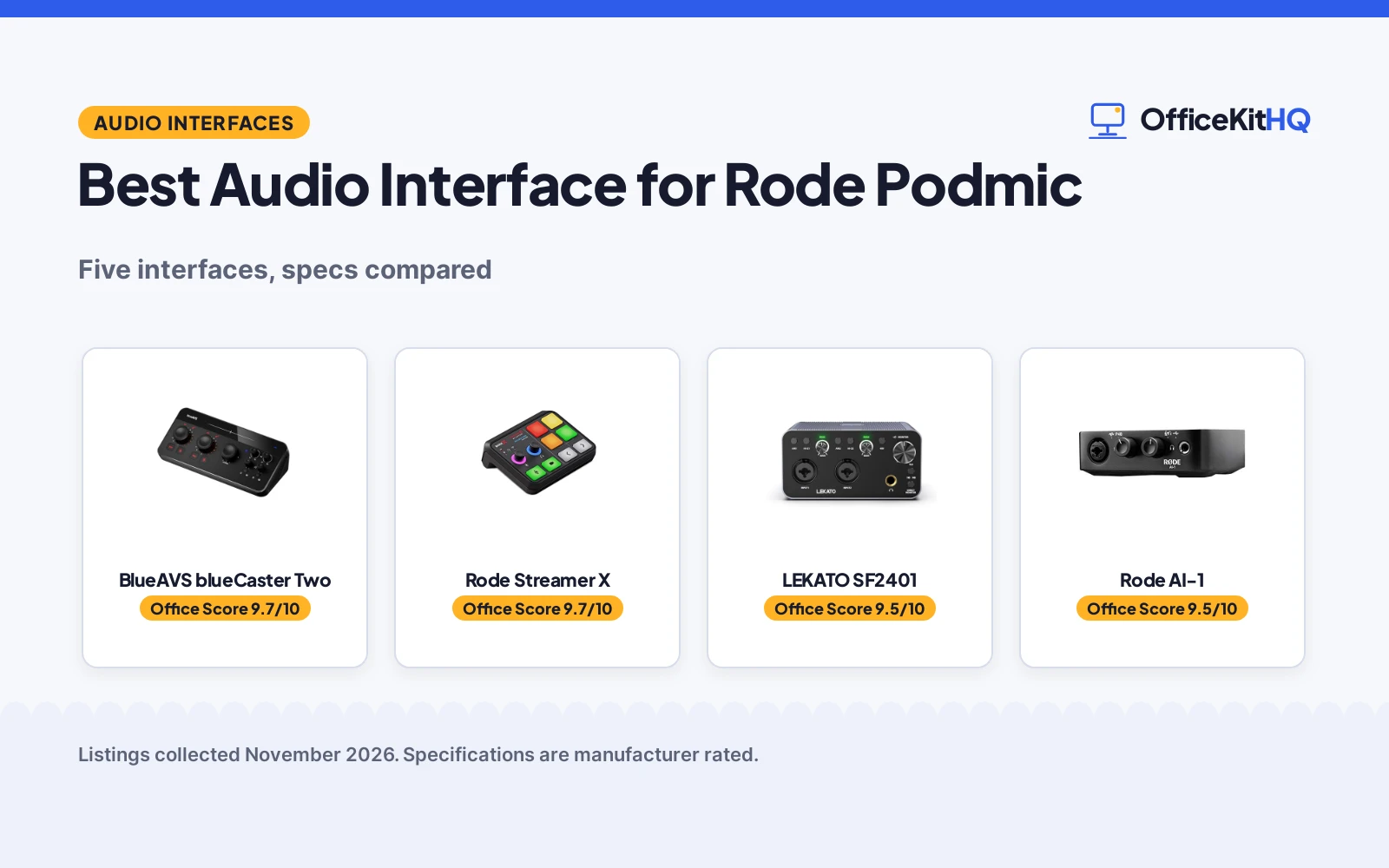
The best audio interface for rode podmic is the box that turns a microphone signal into a recording a computer can use, and the right choice is the interface whose inputs, sample rate and monitoring match how the microphone gets used. A podcast recorded at a kitchen table, a voiceover for a video, or a call where the mic sounds thin all come back to the same small box on the desk. We compared the interfaces below by XLR inputs, sample rate, phantom power, monitoring and warranty term, using only what each listing publishes.
OfficeKitHQ earns a commission when you buy through links on this page, at no extra cost to you. As an Amazon Associate I earn from qualifying purchases. Affiliate disclosure.
Quick picks
 Best Overall BlueAVS blueCaster Two: Dual XLR/TRS inputs, 24-bit/192kHz, 103dB dynamic range Check price on Amazon
 Best for Streaming and Video Rode Streamer X: 4K video capture plus XLR input, dual USB-C, wireless receiver Check price on Amazon
 Best for Guitar and Voice LEKATO SF2401: AIR mode, HI-Z switch, peak indicator at -24, -6 and 0 dBFS Check price on Amazon
 Best Simple Rode Pick Rode AI-1: Single preamp, phantom power, 124 by 38 mm body Check price on Amazon
 Also Listed M-AUDIO M-Track Solo: Title-only listing, kept last for a solo microphone setup Check price on Amazon
Our desk picks
| # | Product | Office Score | Buy |
|---|---|---|---|
| 1 | BlueAVS blueCaster Two | 9.7/10 | Buy on Amazon |
| 2 | Rode Streamer X | 9.7/10 | Buy on Amazon |
| 3 | LEKATO SF2401 | 9.5/10 | Buy on Amazon |
| 4 | Rode AI-1 | 9.5/10 | Buy on Amazon |
| 5 | M-AUDIO M-Track Solo | 9.5/10 | Buy on Amazon |

BlueAVS blueCaster Two
A 2-in/4-out USB interface with dual XLR/TRS combo inputs, 24-bit/192kHz recording, 48V phantom power and zero-latency monitoring in four modes.
Pros
- Dual XLR/TRS combo inputs cover microphones, guitars and line-level devices
- 24-bit/192kHz recording with extended sample rate support
- 103dB dynamic range with THD+N under 0.003%
- PAD switches and independent 48V phantom power for condenser microphones
Cons
- 1.3 lb item weight is the heaviest stated here
- 8.5 by 3.9 by 2.4 in body takes more desk space than the Rode AI-1
- No wireless receiver or video capture, unlike the Streamer X
- USB-A to USB-C cable is included, not a USB-C to USB-C cable
Detailed Review
BlueAVS lists the blueCaster Two as a 2-in/4-out USB audio interface with dual XLR/1/4 in combo inputs for microphones, guitars and line-level devices. Recording runs at up to 24-bit/192kHz, with extended sample rate support, a 103dB dynamic range and THD+N under 0.003%. Zero-latency monitoring runs in four modes, OFF, MONO, Crossfeed and STEREO, through balanced TRS outputs, and independent 48V phantom power and PAD switches cover condenser microphones and high-output instruments. The interface is plug and play over USB-C for Mac and Windows, works with OBS, GarageBand, Logic Pro, Cubase, Ableton Live and Reaper, and ships with a USB-A to USB-C cable and a user manual. The maker backs it with 1-year limited quality coverage for original manufacturing defects.
Who it's for: someone recording voice and instruments through two inputs who wants the widest stated sample rate range and monitoring choice here. Who should skip it: anyone who needs video capture, or a smaller box than the 8.5 by 3.9 by 2.4 in body.
Its Office Score of 9.7/10 comes from performance 32/35, build 21/25, value 21/25, safety 7/10 and warranty 3/5: 84 of 100 points, placed on our 9.2 to 9.8 scale.
Key Specifications
| Inputs | 2 XLR/TRS combo inputs |
|---|---|
| Sample rate | 24-bit/192kHz |
| Dynamic range | 103dB |
| Item weight | 1.3 lb |
These specs mirror the retailer listing as of 19 November 2026; performance figures are stated by the brand.
Safety and Warranty
What this listing states. PAD switches protect against clipping from high-output instruments; zero-latency monitoring with 4 monitoring modes is stated, so safety scores 7 of 10. 1 year manufacturer. It does not say everything a buyer needs, such as who pays return shipping, so warranty scores 3 of 5. See How We Pick.
Protect your hearing. Keep volume moderate during long calls, take breaks, and treat noise cancelling and battery figures as the maker's claims.
This is general buying information, not professional advice. Follow each product manual and local rules, and see our Safety Disclaimer.

Rode Streamer X
An integrated audio interface and 4K video capture card with an XLR input, HDMI in and out, dual USB-C outputs and an on-board wireless receiver.
Pros
- Captures video up to 4K/30fps or 1440p/60fps via HDMI
- HDMI passthrough monitors video in real time up to 4K/60fps
- Neutrik combo input with the Revolution Preamp, stated for broadcast-grade audio
- Dual USB-C outputs connect two computers at once
Cons
- No sample rate is stated for recording
- No phantom power term is stated
- No monitoring mode is stated
- Video capture adds setup steps for audio-only recording
Detailed Review
Rode lists the Streamer X as a compact, fully integrated audio interface and 4K video capture card for streaming with cameras, computers and consoles. It records video up to 4K/30fps or 1440p/60fps via HDMI, and monitors video in real time up to 4K/60fps with HDMI passthrough. A Neutrik combo input takes microphones or line-level devices, coupled with the Revolution Preamp, and dual USB-C outputs connect two computers at once, so one computer can feed video while the other streams. An on-board wireless receiver connects Series IV wireless products, including Wireless GO II, Wireless ME and M2-GO. The maker lists dimensions of 5.6 by 4.8 by 2.0 in and an item weight of 0.84 pounds.
Who it's for: someone streaming with a camera and a microphone who wants video capture and audio in a single box. Who should skip it: anyone recording audio only, since the video features add setup steps and no sample rate is stated.
Its Office Score of 9.7/10 comes from performance 34/35, build 22/25, value 21/25, safety 0/10 and warranty 4/5: 81 of 100 points, placed on our 9.2 to 9.8 scale.
Key Specifications
| Video capture | Up to 4K/30fps |
|---|---|
| Video passthrough | Up to 4K/60fps |
| Dimensions | 5.6 x 4.8 x 2.0 in |
| Item weight | 0.84 lb |
These specs mirror the retailer listing as of 19 November 2026; performance figures are stated by the brand.
Safety and Warranty
What this listing states. No volume limit or safety listing is stated, so safety scores zero. 2 years (extended warranty). It does not say everything a buyer needs, such as who pays return shipping, so warranty scores 4 of 5. See How We Pick.
Protect your hearing. Keep volume moderate during long calls, take breaks, and treat noise cancelling and battery figures as the maker's claims.
This is general buying information, not professional advice. Follow each product manual and local rules, and see our Safety Disclaimer.

LEKATO SF2401
A USB audio interface with an XLR input, 48V phantom power, 24-bit/192kHz recording, an AIR mode, a HI-Z switch and a tri-color peak indicator.
Pros
- 24-bit/192kHz audio resolution for recording
- AIR mode adjusts the input stage to boost high-frequency transparency
- HI-Z switch suits guitar, bass and line-level instruments
- PEAK indicator shows green at -24 dBFS, yellow at -6 dBFS and red at 0 dBFS
Cons
- No dimensions are stated for desk planning
- 3.5 mm headphones need a separate 1/4 to 1/8 TRS converter
- Windows needs drivers installed, while macOS needs none
- No monitoring mode list is stated beyond direct monitoring
Detailed Review
LEKATO lists the SF2401 as a USB audio interface for music and podcasts, powered via USB and compatible with Mac or PC. It captures audio at 24-bit/192kHz, with an XLR input, 48V phantom power, an AIR mode that adjusts the input stage to boost high-frequency transparency, and a HI-Z switch for line-level or instrument inputs such as guitar and bass. A PEAK tri-color indicator on the gain controls shows green at -24 dBFS for signal present, yellow at -6 dBFS near clipping, and red at 0 dBFS for digital clipping. Headphones plug into a 1/4 TRS output for direct monitoring, and 3.5 mm TRS headphones need a 1/4 to 1/8 TRS converter. It is plug and play with no macOS drivers, while Windows needs drivers installed. The maker lists an item weight of 1.06 pounds.
Who it's for: someone recording voice and guitar who wants a peak indicator and an AIR mode in a USB-powered box. Who should skip it: anyone who needs stated dimensions for desk planning, or a second stated input.
Its Office Score of 9.5/10 comes from performance 29/35, build 20/25, value 20/25, safety 6/10 and warranty 0/5: 75 of 100 points, placed on our 9.2 to 9.8 scale.
Key Specifications
| Sample rate | 24-bit/192kHz |
|---|---|
| Phantom power | 48V |
| Peak indicator | -24, -6 and 0 dBFS |
| Item weight | 1.06 lb |
These specs mirror the retailer listing as of 19 November 2026; performance figures are stated by the brand.
Safety and Warranty
What this listing states. PEAK tri-color indicator turns red at 0 dBFS to signal digital clipping, so safety scores 6 of 10. No warranty term, so warranty scores zero. See How We Pick.
Protect your hearing. Keep volume moderate during long calls, take breaks, and treat noise cancelling and battery figures as the maker's claims.
This is general buying information, not professional advice. Follow each product manual and local rules, and see our Safety Disclaimer.

Rode AI-1
A compact USB audio interface with phantom power, one preamp and a 124 by 38 mm body.
Pros
- Phantom power is stated for condenser microphones
- Compact 124 by 38 mm size suits a small desk
- Single preamp keeps the setup simple for one microphone
- USB connectivity keeps the connection to one cable
Cons
- Only one preamp is stated, so a second microphone needs another interface
- No sample rate is stated
- No monitoring mode is stated
- No headphone output is stated for direct monitoring
Detailed Review
Rode lists the AI-1 as a USB audio interface with phantom power and 1 preamp, in a 124 by 38 mm body weighing 560 g. The maker gives two sizes, 124 by 38 mm and 7.0 by 3.0 by 5.0 in; check before ordering. It connects over USB and suits a setup built around a single microphone.
Who it's for: someone who wants a compact Rode interface for one microphone, with phantom power included. Who should skip it: anyone who needs a stated sample rate, a second input, or a stated monitoring mode.
Its Office Score of 9.5/10 comes from performance 28/35, build 20/25, value 20/25, safety 0/10 and warranty 3/5: 71 of 100 points, placed on our 9.2 to 9.8 scale.
Key Specifications
| Size | 124 x 38 mm |
|---|---|
| Item weight | 560 g |
| Preamp | 1 |
| Phantom power | Stated |
These specs mirror the retailer listing as of 19 November 2026; performance figures are stated by the brand.
Safety and Warranty
What this listing states. No volume limit or safety listing is stated, so safety scores zero. 1 year. It does not say everything a buyer needs, such as who pays return shipping, so warranty scores 3 of 5. See How We Pick.
Protect your hearing. Keep volume moderate during long calls, take breaks, and treat noise cancelling and battery figures as the maker's claims.
This is general buying information, not professional advice. Follow each product manual and local rules, and see our Safety Disclaimer.
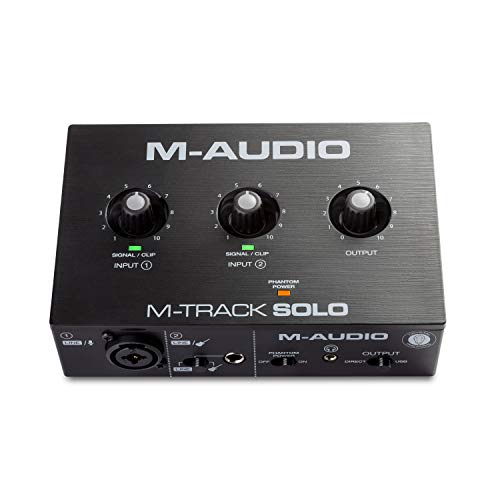
M-AUDIO M-Track Solo
A one-input USB interface with one combo XLR input, 48kHz resolution and stereo RCA outputs for recording, streaming and podcasting.
Pros
- One combo XLR/Line input with phantom power
- Stereo RCA outputs with a 1/8 inch headphone output
- USB/Direct switch for zero-latency monitoring
- Includes MPC Beats software from Akai Professional
Cons
- 48kHz resolution, lower than the 192kHz picks here
- 1-year warranty, tied for the lowest term here
- No MIDI connection is stated
- No gain figure is stated for the Crystal Preamp
Detailed Review
M-AUDIO lists the M-Track Solo as a USB interface with one combo XLR/Line input with phantom power, one Line/Instrument input and 48kHz audio resolution. The listing states a 1/8 inch headphone output, stereo RCA outputs, a USB/Direct switch for zero-latency monitoring and MPC Beats software from Akai Professional. The listing states a 1-year manufacturer warranty and a 0.6625 lb body.
Who it's for: a recorder or podcaster who needs one mic input and simple monitoring on a portable interface. Who should skip it: anyone recording two mics at once, since this interface has one combo XLR input.
Its Office Score of 9.5/10 comes from performance 28/35, build 20/25, value 20/25, safety 0/10 and warranty 2/5: 70 of 100 points, placed on our 9.2 to 9.8 scale.
Key Specifications
| Inputs | 1 combo XLR/Line |
|---|---|
| Resolution | 48kHz |
| Headphone | 1/8 inch output |
| Weight | 0.6625 lb |
Figures as published on the retailer listing, collected 10 November 2026. Performance figures are manufacturer rated.
Safety and Warranty
What this listing states. This product does not plug in or run on a battery, so safety is not part of its score. 1-year manufacturer warranty stated. It does not say everything a buyer needs, such as who pays return shipping, so warranty scores 2 of 5. See How We Pick.
Protect your hearing. Keep volume moderate during long calls, take breaks, and treat noise cancelling and battery figures as the maker's claims.
This is general buying information, not professional advice. Follow each product manual and local rules, and see our Safety Disclaimer.
As an Amazon Associate I earn from qualifying purchases.
Specs compared
| Audio Interface | Office Score | Inputs | Sample rate | Phantom power | Monitoring | Warranty | Amazon |
|---|---|---|---|---|---|---|---|
| BlueAVS blueCaster Two | 9.7/10 | 2 XLR/TRS combo inputs | 24-bit/192kHz | 48V | Zero-latency, 4 modes | 1 year | View on Amazon |
| Rode Streamer X | 9.7/10 | Neutrik combo input | Not stated | Not stated | Not stated | 2 years | View on Amazon |
| LEKATO SF2401 | 9.5/10 | XLR input | 24-bit/192kHz | 48V | Direct monitoring | Not stated | View on Amazon |
| Rode AI-1 | 9.5/10 | 1 preamp | Not stated | Phantom power stated | Not stated | 1 year | View on Amazon |
| M-AUDIO M-Track Solo | 9.5/10 | Not stated | Not stated | Not stated | Not stated | Not stated | View on Amazon |
Specs reflect manufacturer claims on each product listing (as of 19 November 2026). Three of the five state a warranty term; two state a safety feature.
How to choose the best audio interface for rode podmic
Start with the inputs
Inputs decide what can plug in. The BlueAVS states 2-in/4-out with dual XLR/TRS combo inputs, so a microphone and a guitar or line-level device can connect at once. The Streamer X states a Neutrik combo input for microphones or line-level devices, the AI-1 states 1 preamp, and the LEKATO states an XLR input. The M-Track Solo states no input at all, which is why it sits last here. If the setup already has an XLR cable, any of the four with a stated XLR input will take it; if an extra microphone joins later, only the BlueAVS states a second input.
Sample rate and monitoring
Sample rate is the number that sets the ceiling on recording detail. The BlueAVS and the LEKATO both state 24-bit/192kHz recording, and the BlueAVS lists extended sample rate support up to 24-bit/192kHz. The Streamer X, the AI-1 and the M-Track Solo state no sample rate, so there is nothing to compare on that line. Monitoring matters just as much: the BlueAVS offers zero-latency monitoring in four modes, OFF, MONO, Crossfeed and STEREO, and the LEKATO offers direct monitoring with a tri-color peak indicator that turns red at 0 dBFS.
| Audio Interface | Inputs | Sample rate | Monitoring |
|---|---|---|---|
| BlueAVS blueCaster Two | 2 XLR/TRS combo inputs | 24-bit/192kHz | Zero-latency, 4 modes |
| Rode Streamer X | Neutrik combo input | Not stated | Not stated |
| LEKATO SF2401 | XLR input | 24-bit/192kHz | Direct monitoring |
| Rode AI-1 | 1 preamp | Not stated | Not stated |
| M-AUDIO M-Track Solo | Not stated | Not stated | Not stated |
Figures as stated in each listing. A higher sample rate suits music production and detailed vocal work; for spoken-word recording, the monitoring modes and the peak indicator matter more day to day.
Phantom power and the microphone
Phantom power is the 48V supply that condenser microphones need, and three of the five interfaces state it: the BlueAVS and the LEKATO state 48V, and the AI-1 states phantom power. The Streamer X and the M-Track Solo state no phantom power term. For a setup built around one microphone, the AI-1 keeps the chain short with a single preamp and phantom power in a 124 by 38 mm body. For a setup that also records guitar, the LEKATO adds a HI-Z switch and an AIR mode, while the BlueAVS adds PAD switches that protect against clipping from high-output instruments. A podcast audio interface roundup on this site covers the same ground for spoken-word recording.
Warranty and desk space
Three of the five state a warranty term. The Streamer X states 2 years (extended warranty), and the BlueAVS and the AI-1 each state 1 year. The LEKATO and the M-Track Solo state no warranty term. Desk space is the other practical check: the Streamer X is listed at 5.6 by 4.8 by 2.0 in, the BlueAVS at 8.5 by 3.9 by 2.4 in, and the AI-1 at 124 by 38 mm, while the LEKATO and the M-Track Solo state no dimensions. A USB microphone setup guide on this site walks through placement and cable runs for a desk like this one.
Setup Notes
- Measure the desk space first: the Streamer X is listed at 5.6 by 4.8 by 2.0 in, the BlueAVS at 8.5 by 3.9 by 2.4 in, and the AI-1 at 124 by 38 mm; the LEKATO and the M-Track Solo state no dimensions.
- Plan the cables: the Streamer X uses dual USB-C outputs and HDMI in and out, the BlueAVS includes a USB-A to USB-C cable, and the LEKATO takes a 1/4 TRS headphone plug, with a converter needed for 3.5 mm headphones.
- Check the power: the BlueAVS and the LEKATO state 48V phantom power, the AI-1 states phantom power, and the Streamer X and the M-Track Solo state none.
- Leave room for monitoring: the BlueAVS offers four monitoring modes and the LEKATO offers direct monitoring, while the other three state no monitoring mode.
FAQ
Which of these interfaces lists the highest sample rate?
The BlueAVS and the LEKATO both state 24-bit/192kHz recording. The Streamer X, the AI-1 and the M-Track Solo state no sample rate.
Which interfaces state 48V phantom power?
The BlueAVS and the LEKATO state 48V phantom power, and the AI-1 states phantom power. The Streamer X and the M-Track Solo state none.
Which interface also captures video?
The Rode Streamer X captures video up to 4K/30fps or 1440p/60fps via HDMI, and its HDMI passthrough monitors video in real time up to 4K/60fps. The other four are audio only.
How many inputs do these interfaces have?
The BlueAVS states 2-in/4-out with dual XLR/TRS combo inputs, the Streamer X states a Neutrik combo input, and the AI-1 states 1 preamp. The LEKATO states an XLR input without a count, and the M-Track Solo states none.
Which interface states the longest warranty?
The Rode Streamer X states 2 years (extended warranty). The BlueAVS and the AI-1 each state 1 year, and the LEKATO and the M-Track Solo state no warranty term.
Score breakdown
The Office Score weighs performance (inputs, sample rate and capture features), build (size, weight and stated construction), value for the stated specs, safety and warranty. For an audio interface, safety means stated protection against clipping and overload, such as PAD switches and a peak level indicator; the BlueAVS and the LEKATO state one, the other three do not. Three listings state a warranty term: the Streamer X at 2 years and the BlueAVS and the AI-1 at 1 year. How we pick explains the weights.
| Product | Office Score | Perf. /35 | Build /25 | Value /25 | Safety /10 | Warranty /5 |
|---|---|---|---|---|---|---|
| BlueAVS blueCaster Two | 9.7 | 32 | 21 | 21 | 7 | 3 |
| Rode Streamer X | 9.7 | 34 | 22 | 21 | 0 | 4 |
| LEKATO SF2401 | 9.5 | 29 | 20 | 20 | 6 | 0 |
| Rode AI-1 | 9.5 | 28 | 20 | 20 | 0 | 3 |
The scale opens at 9.2 and closes at 9.8; between those marks, weighted points translate linearly into the score you see.
More for your workspace
See every audio, power and connectivity guide and all home studio guides. Also see our best audio interface for podcast. Also see our best audio interface for beginners. Also see our best audio interface for home recording. Also see our best audio interface. Also see our best XLR cable for audio interface.
More related guides (5)
More picks: headsets, computer speakers, docking stations and USB hubs.